Category Archives: Theater

THE CAPTIVE MIND: THEN AND NOW: PART 1

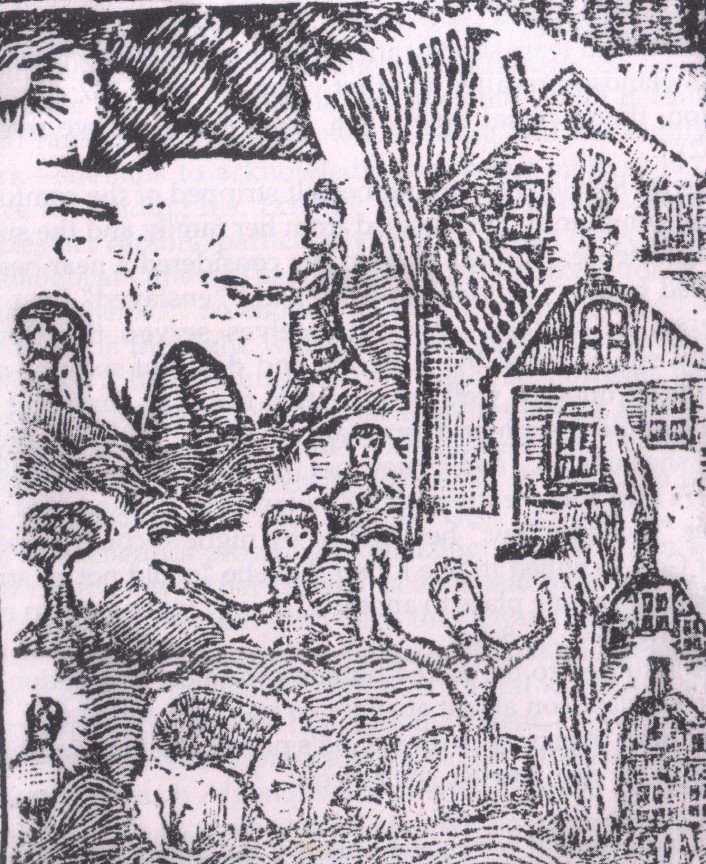
MARY ROWLANDSON was already the captive of a religious cult before the Natives of New England grabbed her during a raid in 1676, she just didn’t know it. (Woodcut of Rowlandson’s kidnapping. Reprinted in Captive Selves, Captivating Others by Pauline Turner Strong
Like Mary, I was born into a similar updated version of this cult—three hundred years later (at least burning/hanging witches stopped, for now).

By the time of her abduction during KING PHILIP’S WAR, the beginning of the real end for the sovereignty of New England’s Native People, Mary had lived her forty years in the religious movement called Puritan, so-called by their peers. Puritans professed to lead a life of purity, a life of pure thoughts, a life dedicated to finishing what the Protestant Reformation had started the century before—eliminate any residual popish rituals in the Church of England. Of course, many Englishmen liked their Church just the way it was.

So, Puritans immigrated to America starting with the Mayflower in 1620 to not only escape persecution, but to build a New Jerusalem in a new, pure environment, free to rule their city-on-a-hill without any pesky King or Archbishops to interfere.

Soon after, their hero, OLIVER CROMWELL, seized power with the help of his New Model Army and lobbed off King Charles’ head, but ten years later, Cromwell was dead, and the throne was restored to Charles’ son. In spite of it all, the Puritans of New England forged ahead, and by this time (1660) they outnumbered their Native neighbors by at least three to one. European diseases had killed many Natives, who some ethnographers think numbered 144,000 in New England circa 1600, shrinking to a mere 15,000 by 1620. Entire villages…gone (Page 174).

Puritans modeled their Churches of Christ (Winthrop 264) after the Christian church of the first century following the death of Jesus (at least their vision of what the church was like), a primitive Christianity based on the letters of the Apostles in the Geneva Bible, the preferred version for the English dissenters.

My Church of Christ is a modified version, but still sticking to their patriarchal, misogynistic attempt at a first century model. Of course, any generality is fraught with danger, but a large block of the Republican Party traditionally votes for candidates that favor dictating moral behavior that melded into that old tune of what came to be called manifest destiny.

After all, God is on their side.

Like me, Mary was born into this cult. Mary’s father, Puritan John White, brought his family to New England in 1638 during the Great Migration, when Mary was three, and had moved through the forest to Lancaster about forty miles from Boston around 1652, which at that time was the “vast and desolate wilderness” (Lincoln 132). Mary experienced life through the Bible-tinted glasses of a New England Puritan, a life that was conditioned from birth to believe only the Saints (Puritans) would inherit the Kingdom of God, if they measured up right.

Puritans constantly searched “for clues to God’s purposes” (Fischer 125), and the Natives were obviously sent by the Devil to test their faith. The Puritan Priest, INCREASE MATHER, wholeheartedly agreed with his predecessor and father-in-law, John Cotton. “The conversion of the Indians is not to be expected […] before the conversion of the Jewish Nation” (Mather 4). Cryptic scriptures were dredged up to justify the wholesale slaughter of innocent Native women and children. “I will bring a sword upon you, that shall avenge the quarrel of the Covenant, Leviticus 26:25” (Mather 1). The Bible was their creed, a malleable text to justify their every edict or law, then as now.

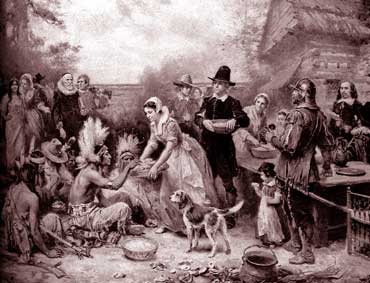
In the course of researching my MAYFLOWER genealogy, I stumbled across THE STORY OF MARY BEING WEETAMOO’S SLAVE. In fact, I don’t remember any American history class I took that talked much about the 17th century. The nice Thanksgiving picture with Indians and Pilgrims getting along would dissolve into the next big event—the American Revolution. Not much happened in between, right? Wrong.

The contrast between Weetamoo and Mary Rowlandson could not have been more stark
. Weetamoo was born a beloved Queen in her community. Mary was born a wretched sinner and as a woman, a second-class citizen (Fischer 84). Weetamoo was a warrior, Mary was a homemaker (I’m not suggesting this is bad), and the list continues. In the Puritan world women carried then and now the burden of their sex causing the downfall of the entire human race, thanks to Eve’s dalliance with the snake in the Garden of Eden. This event is still taught as fact. And how about the planet being 6012 years old? What’s wrong with you scholars, can’t you add up all the begets in the Bible’s Old Testament?

I was told to ignore what I learned at school. No dancing, no swimming with the opposite sex, no sex for fun, in fact, don’t even mention the word sex. No musical instruments in church. No asking questions.

Puritans censor a wide-ranging selection of words and artistic endeavors, such as literature, art, film, and skinny-dipping.

Mary was unable to see Weetamoo and Natives, in general, as human beings
. The Native propensity for nakedness shocked Puritans. Adam and Eve in Genesis were ashamed of their nakedness. Why not these Natives? Native People were wolves, heathens—wicked creatures of the night. Mary didn’t see Weetamoo’s religion or its rituals. She didn’t see their villages as communities, but rather dens of wolves. The natural environment was not a rich, ancient forest, but a “vast and howling wilderness” (Lincoln 134). Puritans, like many Europeans, believed “unicorns lived in the hills, […] mermaids swam in waters, […] tritons played in Casco Bay,” and of course, witches must be burned (Fischer 125). As late as the 18th century, artistic drawings suggest Europeans in general “still had a hard time actually seeing Indians” (Page Centerfold). (“Drawing of the Savages of Several Nations.” Alexandre de Batz (1735). Reproduced In The Hands of Great Spirit.” Jake Page.)

Mary was eventually ransomed back to her husband and reunited with two of her children. One daughter died during her captivity, but Weetamoo (her children had already died) and what was left of her family died soon after. The Puritans stuck Weetamoo’s head on a pole at Taunton, the site of her ancient homeland. At seeing this head, members of her tribe in the stockade sobbed, “Our Queen…our Queen is dead” (Mather 137).

Mary returned to her Puritan life and was encouraged to write her captivity story, most likely by Mather, who may have written the introduction, perhaps in part to stop any nasty rumors of her defilement (read sex) from the hands of any “savages,” a common problem for any woman returning to Puritan communities from captivity (Strong 101), although rape of English women by Native men was an uncommon occurrence. Of course, if Mary willingly had sexual relations with a Native man, she would have been branded or worse.

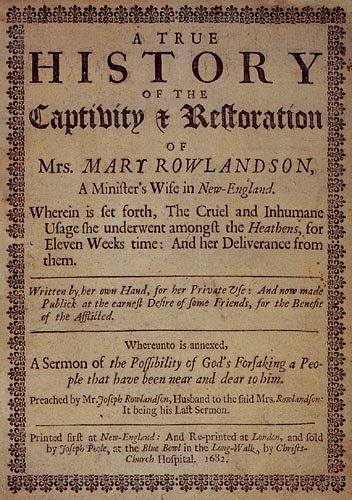
MARY’S BOOK also provided a fresh text for Mather and friends to use in the pulpit as propaganda against Native People. Sometimes even the Bible didn’t frighten the flock as well as a good, scary story in their own backyard, using fear to control people—straight out of the Puritan-like strategy book. Captivity narratives became all the rage after Mary published her book.
Now as then, the struggle to think clearly continues.

WORKS CITED

Dillaway, Newton, ed. The Gospel of Emerson. Mass: The Montrose P, 1949.

Winthrop, John. “On Liberty.” 1645. Constitution Society.5 Aug 2008 http://www.constitution.org/

Lincoln, Charles H., ed. Narratives of the Indian Wars 1675 – 1699. New York: Scribner’s Sons, 1913.

Mather, Increase. A Brief History of the Warr with the Indians in New-England (1676). Ed. Paul Royster. Nebraska: U of Nebraska, 2006. 8 Aug 08

Page, Jake. In The Hands of the Great Spirit: The 20,000 -Year History of American Indians. USA: Free Press, 2003.

Philbrick, Nathaniel. Mayflower: A Story of Courage, Community, and War. USA: Penguin, 2007.

Strong, Pauline Turner. Captive Selves, Captivating Others: The Politics and Poetics of Colonial American Captivity Narratives. USA: Westview P, 1999.

More information and links: http://www.conradreeder.com/TheCaptive.htm

Conrad “Connie” Reeder was born in Columbus, Ohio.  BA Liberal Arts and a MFA in Film, Theater, & Communication Arts with a concentration in Playwriting.

The Captive is a dramatic play in two acts.

Contact: conradreeder@gmail.com

© All Rights Reserved

The Captive: A Tale of Weetamoo and Mary


In a land and time not far away, a Native American Queen lived by the name of Weetamoo. Her culture had survived thousands of years until disease, greed and a religion sparked a movement that destroyed her world in just a few generations.

As Weetamoo and her allies battled the encroaching English colonists, warriors captured a Puritan minister’s wife by the name of Mary Rowlandson. For a brief period, Mary was Weetamoo’s slave.

The Captive revolves around the story of these two women from stridently different worlds who are caught up in a fight for survival during King Philip’s War (1675-76). The entire landscape of New England would be forever changed by this war.

As for the two women–one survived the war, the other was reborn a legend.

The full-length play can be found here:

© Conrad Reeder
All Rights Reserved
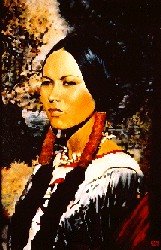
Painting: Indian Princess by Anthony Gruerio

The Phantastical Gothic Ghost of Horace Walpole

 by

C. Reeder

otrantofootHorace Walpole (1717-97) wrote a ghost story, but not just any ghost story. The dire events and super-sized shade of Prince Alfonso in The Castle of Otranto spooked the reading public, and catapulted Walpole to literary fame.

Otranto was criticized for its thin characters, and outlandish machinations (Clery, Rise 84), but others, like Sir Walter Scott, found the story “grand, tragical, and affecting, (and concluded that) applause which cannot be denied to him who can excite the passions of fear and of pity must be awarded to the author of The Castle of Otranto” (Lewis 158). The new consumer reading public snatched up every copy, and publishers since then have printed over a hundred editions.

Otranto and its ghost contributed to the birth of an entirely new type of novel, a Gothic novel which combined “the ancient and the modern” (9), flaunting a supernatural twist that stood alone, free from the dictates of religious dogma, and wound down through the centuries, sprouting many literary branches on its way to our current age, like Francis Ford Coppola’s Dracula.

A distinct age of reason and enlightenment had seized the educated minds of Europe in the eighteenth century, so why would a privileged politician and part-time intellectual, albeit a dilettante, stir up a hornet’s nest, and bring back the so-called superstitious barbarism of the Gothic age when the literati had worked so hard to eliminate it, and the clerics claimed supernatural phenomena strictly their domain?

Walpole sidestepped the condemnation of clerics, and the censure of critics by going straight to the source: the reading public.

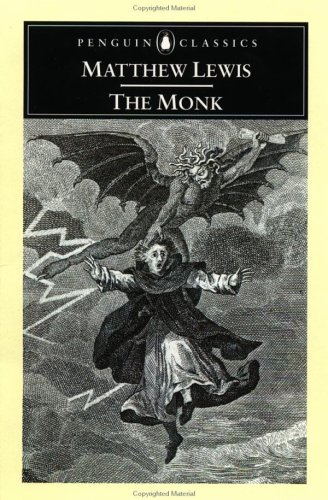
Otranto survived the cthe-monkriticisms because of the eighteenth century “rise of consumerism” (Clery, Rise 5). People bought the book, and the template for terror in Otranto inspired many later romantic novelists to copy its winning formula, the most famous example in the 1790s being The Monk by Matthew Lewis.

In Walpole’s opinion, “the great resources of fancy have been dammed up” (9). Walpole imagined an undeniable ghost the size of King Kong to break down that dam.

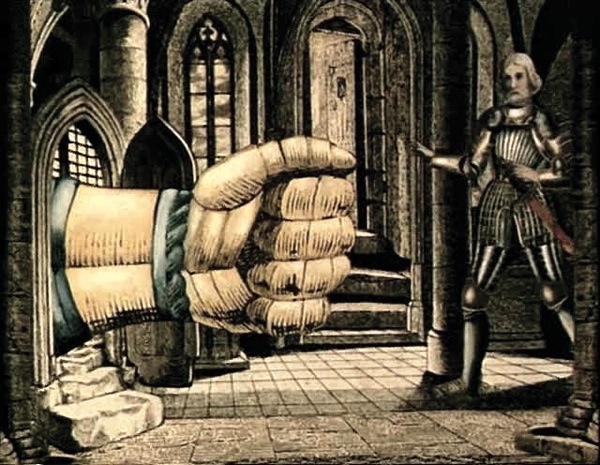
The Castle of Otranto was not the doodling of a delusional youth, but the product of a mature writer with an ax to grind. Before Otranto, Walpole published Anecdotes of Painting in England (1962), and was considered an expert on antiquarian artifacts and Gothic architecture (Lewis 167). Walpole was forty-seven when he wrote Otranto, and lived in a pseudo Gothic castle he had built from scratch. He claimed he saw a ghost in a nightmare, specifically “a gigantic hand in armour” (Clery, Intro vii). WithinWalpole1793 two months he wrote the story to keep his mind off politics with a passion likened to automatic writing (Lewis 161).

Two years before the ghost of Alfonso showed up in Walpole’s nightmare, a ghost of smaller proportions, the Cock Lane ghost of 1762, became “the talk of London” (Clery, Rise 13). Later demystified and exposed as a fraud, the ghost of a murdered woman supposedly scratched on the wall in response to questions, and attracted throngs of people from all strata of society day and night.

Hogarth Print, Thomas Cook 1744-1818, printmaker.

The event was likened to theatre and “commercial exploitation” (Clery, Rise 15). David Garrick’s successful play at Drury Lane, The Farmer’s Return, was representative of the enormous attention given to this ghost. Essentially, the play mocked the credulity of city-folk, a reversal of the belief that only ignorant country-folk believed in ghost stories (Clery, Rise 16).

Walpole believed that “a god, at least a ghost, was absolutely necessary to frighten us out of too much senses” (Walpole, Letters Vol. 3 381), a slam against didactic “sensibility” novels of the day, like the wildly popular Samuel Richardson’s Pamela and Clarissa.  Many Englishmen agreed with Walpole. In a Preface to Faliero, Lord Byron praised author Walpole for not writing another “puling (whiny) love-play” (Walpole, Letters Vol. 1).


Walpole in  his Gothic Castle Strawberry Hills
Walpole in his Gothic Castle Strawberry Hills

One can imagine the slightly built Walpole in a trance, hovered over his manuscript with a Victor Frankenstein-like intensity in the act of creating a monster. Sunlight filters through a gothic stained glass, casting an array of colors over Walpole’s shoulder as it inches across the floor on a summer evening in 1764. The room around him dims, until the only light is from an oil lamp shining on the page he feverishly scribbles on into the wee hours. He later writes his friend Cole that his “hand and fingers were so weary, that he could not hold the pen to finish the sentence” (Clery, Intro vii).

The intensity of physical pain and sexual tension in Otranto must have had a cathartic affect on Walpole, and offered a release for pent-up imaginative fantasies, or a sedative for his nerves and brain. Burke wondered if these fanciful thoughts were “a sort of delightful horror (or) exercise necessary for the finer organs” (Burke 123).

Otranto ghost hand
Hand of the ghost of Otranto confronting the villian
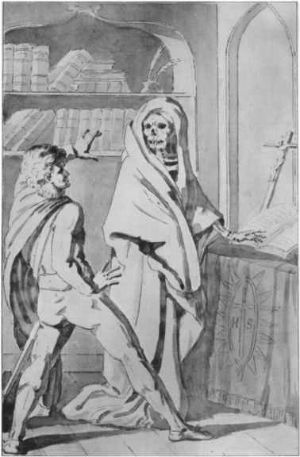
OtrantoSkeleton
Skeleton in The Castle of Otranto

Even with all the praise, Walpole did not see the immediate success of the genre Gothic. He admitted to Mme du Deffand, “I have not written for this century, which wants only cold reason” (Lewis 161). Yet, under the guise of offering a new literature, Walpole indulged his creative urges, and in the process formed a template for a ghost, and a storyline that did not vaporize into the questionable ether, nor direct the reader’s loyalties toward a particular religious dogma. Some laughed at the ghost of Alfonso for its ‘machinations’, but Walpole was unmoved. “If I have amused you by retracing with any fidelity the manners of ancient days, I am content” (Walpole, Letters Vol. 3 378).

Walpole’s murderous shade is a device of dynamic “terror, the author’s principle engine” (6). With a ghost of such an “immense magnitude” (112), its existence cannot be ignored, or denied. The phantasmal ghost of Alfonso still lives on as a relic of an early attempt to scintillate, possibly scare, or simply entertain. Most likely, future generations will continue to be haunted by dank castles, creepy ghosts, miraculous events, and romantic terrors. The human need for romance and mystery seems bottomless.

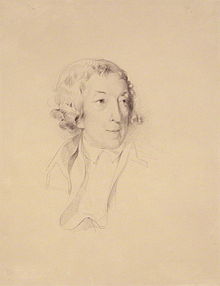
Oldhorry Sir Thomas Lewis 1795
“Old Horry” Sir Thomas Lawrence 1795
Works Cited
Botting, Fred. Gothic. New York: Routledge, 1996. Print.
Burke, Edmund. A Philosophical Enquiry into the Origin of our Ideas of the Sublime and
Beautiful. 1754. Ed. Adam Phillips. Oxford: Oxford UP, 1990. Web.
Byrne, James M. Religion and the Enlightenment: From Descartes to Kant. Louisville:
Westminister John Knox P, 1997. Web.
Clery, E.J. The Rise of Supernatural Fiction: 1762 – 1800. Cambridge: Cambridge UP, 1995. Print.
—, Introduction. The Castle of Otranto: A Gothic Story. By Horace Walpole. Oxford: Oxford UP, 1996. vii–xxxiii. Print.
Daniels, Barry V. Revolution in the Theatre: French Romantic Theories of Drama. Westport: Greenwood P, 1983. Web.
Finch, M. B. and Allison E. Peers. Walpole’s Relations with Voltaire. Modern Philology 18.4. (1920): 189-200. Web.
Johnson, James William. Horace Walpole and W. S. Lewis. The Journal of British Studies 6.2. (1967): 64-75. Web.
Johnson, Samuel. The Critical Opinions of Samuel Johnson. Ed. Joseph E. Brown. Princeton: Princeton UP, 1926. Web.
Lewis, Wilmarth Sheldon. Horace Walpole. New York: Pantheon, 1961. Web
Sandner, David. Ed. Fantastic Literature: A Critical Reader. Westport: Praeger, 2004. Web
Shakespeare, William. Hamlet: Prince of Denmark. Complete Works of William Shakespeare. Contr. Germaine Greer, Anthony Burgess, Alec Yearling, and PeterAlexander. Glasgow: HarperCollins, 1994. 1079-1125. Print.
Voltaire. Candide: or Optimism. Intro. and trans. John Butt. London: Penguin, 1947. Print.
—, Philosophical Dictionary. Ed. and trans. Theodore Besterman. London: Penguin,Print.
Walpole, Horace. The Castle of Otranto: A Gothic Story. 1764. Ed. W. S. Lewis. Oxford:Oxford UP, 1998. Print.
—, The Letters of Horace Walpole, Earl of Orford: Volume 2. Ed. Peter Cunningham. London: Putnam, 1840. Project Gutenberg. 3 Apr 2007
—, The Letters of Horace Walpole, Earl of Orford: Volume 2. Ed. Charles Duke Yonge.London: Putnam, 1890. Project Gutenberg. 3 Apr 2007
—, The Letters of Horace Walpole, Earl of Orford: Volume 3. Project Gutenberg. 3 Apr 2007 <http://www.gutenberg.org/>
—, The Letters of Horace Walpole, Earl of Orford: Volume 4. Ed. Lea And Blanchard.Philadelphia: Sherman, 1842. Project Gutenberg. 3 Apr 2007
©All Rights Reserved. A paper submitted  25 Apr 2007 for Professor Barbara Fitzpatrick’s “Studies in 18th Century Literature” (UNO).

GODDESSES, WHORES, WIVES, & SLAVES: The Archetypal Roles Assigned to Women in Theatre. Part 2: Women Write Plays, Too!


Euripides’ Medea (431 B.C.E.) does not go gently into the night, and some of her lines are the first uttered on a public stage in the defense of women.

Then they also say that whilst we live quietly and without any danger at home, the men go off to war. Wrong! One birth alone is worse than three times in the battlefield behind a shield (lines, 248-49).


The only notorious female writer of this ancient time in any genre is Sappho born about 612 B.C.E. and all that remains of her work is a single poem and fragments of others. In antiquity, Sappho was commonly regarded as one of the greatest lyric poets. An epigram in the Anthologia Palatina (9,506) ascribed to Plato says, “Some say the Muses are nine: how careless! / Look, there’s Sappho too, from Lesbos, the tenth” (Campbell, D.A.)


Sappho’s alleged bi-sexuality alluded to in the few remaining fragments of her poetry offended people throughout history; her books burned by Christians in the year 380 C.E. at the instigation of Pope Gregory Nazianzen. Another book burning in the year 1073 C.E. by Pope Gregory VII may have wiped out any remaining trace of Sappho’s works (duBois).

It’s been a slow crawl from a woman’s pen to the page to the public stage. Virtually no female playwright appeared in the West until the 10th century C.E. German Benedictine nun known as Roswitha or Hrotsvit von Ganderwhelm (Case 533). Roswitha penned six plays that are extant, following the form of the lax moral comedic plays by the 2nd century C.E. Roman playwright, Terence, albeit framed with a stiff moral Catholic slant.

But the first woman to make a living as a popular dramatist in the West, and the first female playwright covered in this essay (and an undergraduate course I designed as part of my Masters Degree Thesis) is Aphra Behn (1640 – 1689), who wrote during the period of the English Restoration Theatre (1610-1710). Denounced by the American literary critic, Harold Bloom, as a fourth-rate playwright, Behn was nonetheless hailed by Virginia Woolf in A Room of One’s Own.

All women together, ought to let flowers fall upon the grave of Aphra Behn… for it was she who earned them the right to speak their minds.

Woolf believed Behn’s total career to be more important than any particular work produced. However, Behn’s work still gets staged. At a recent performance (2003) of The Rover in Oakland, the reviewer called Behn’s role reversal scheme “spirited and saucy” (Jones).

Behn, a former spy for Charles II, might have settled the argument with the first line from the Prologue of The Rover:

Wits, like Physicians, never can agree, / When of a different Society.

From this point forward, women slowly made inroads into the male-dominated theatre. After the Puritan shut down of theatres in London for a decade, the atmosphere in London at the reopening of the theatres after the Restoration (1660) was festive, and women appearing on the legitimate stage for the first time was not (I believe) coincidental with Behn’s debut as the first professional English female dramatist.

Women seized the moment: Hannah Cowley, Susannah Rowson, Susan Glaspell (Pulitzer Winner), Sophie Treadwell, Lillian Hellman, Gertrude Stein, Wendy Wasserstein (Pulitzer Winner), Caryl Churchill, Ntozake Shange, Marsha Norman, Emily Mann, Margaret Edson, Alice Childress, Adrienne Kennedy, Megan Terry, Theresa Rebeck, Beth Henley(Pulitzer Winner), Sarah Kane, Caridad Svitch, Lorraine Hansberry, Maria Irene Fornés, Marsha Norman (Pulitzer Winner), Wakako Yamauchi, Spiderwoman Theatre (Native American), and many more have all contributed to the growth of Western theatre since Behn broke the all-male rule.

Another radical playwright vilified and adored in her own time was Mae West (1892-1980).

Middle and upper class white women generally dominated the women’s movement, one that would have certainly disapproved of Mae (Watts 106).

Exclusion of West’s plays from Murphy’s Cambridge anthology about women playwrights has much to do with critical readings of her plays, but I would argue that who or what she represented to the general public—-an independent, sensual woman who maintained a Goddess Archetype in spite of her Whore behavior, seized the same sexual freedom for women as men had always enjoyed. This was an unconventional Archetype for mortal women, as ground-breaking in society at large as the right to vote was empowering.

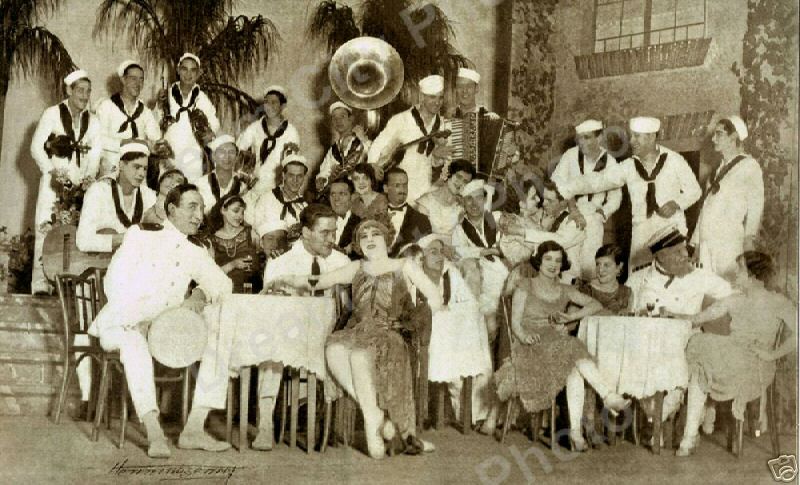
These days the discussion of West’s first hit play titled, Sex, (which has no sex in it) should be an enlightening experience for young people in the twenty-first century who have been sexually saturated by society and the media.

(West & Cast of her Broadway show, Sex (1926)

The Westian use of double and triple entendre to convey sexual images is a refreshing study in form and dialogue. No playwright before West had ever done this.

“attacked respectable women from the stage… of being whore(s) in disguise” (Schlissel 9).

West also opened the closet for the gays of New York City with her play, The Drag, which earned her jail time for her effort. In 1927, gays were the victims of viscous beatings by the New York City police. West was a major force behind legitimizing the gay subculture (Schlissel 11). Examining why West’s female brand of Archetype dominated the British/American stage and Hollywood movies for decades and during a depression era has merit in any study of plays by and about women. By designing her own unique Whore/Goddess that rejected male domination, West, a working class woman, offered “an early feminist role model” (Watts 107) whether certain feminists like it or not.

And then there is Suzan-Lori Parks.
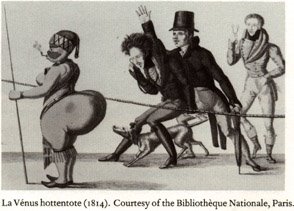
Her play Venus exposed the vicious true story of the evil treatment of Saartjie Baartman, an African woman who was displayed in Europe (1789-1815) as a freak show because of her unusual buttocks.


This Hottentot Venus is a Goddess/Virgin defiled and reassigned the role of Slave, and then Whore. The slavic safety of domesticity is not an option for this woman. Parks satirizes the insanity of it all by using a Greek Chorus, a harkening back to a time when women were banned from theatre, just as Baartman is banned from life.

Parks is the Goddess Archetype in her own life drama–the story of the first African American woman to win the Pulitzer Prize for Drama (2002) with her play, Topdog/Underdog; a play with only two characters—two male characters.

The boundaries of sex no longer apply. Women playwrights have joined their Archetypes center stage.


(Piccolo Spoleto theatre production of Topdog/Underdog, Charleston, S.C. 2006. Pic & article found here.

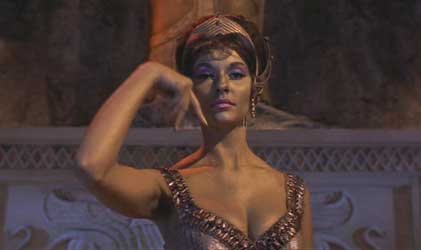
*Nancy Novak as Medea in Jason and the Argonauts (1963)

Works Referred To: Go to Part 1 of this essay.

Note: This essay is the introduction to an undergraduate class in Theatre History.

WHAT DO ANN BOLEYN & WEETAMOO HAVE IN COMMON?

What do Anne Boleyn and Weetamoo of Colonial New England have in common? They were both Queens and both had their heads chopped off.


The Captive
presents the story of Weetamoo, a Native American Queen in 17th century New England, who led her Pocasset braves (the ones who survived the scourge of European diseases) in battle against the invading English and their Native Allies during King Philip’s War (1675-76). The Colonial Army was organized under the auspices of the United Colonies, a body formed to combat Natives that evolved into an enduring institution, eventually challenging their overlord, the British Crown, a hundred years later in the American Revolution.

King Philip’s War (Metacom) was the last concerted effort of coastal northeast Woodland Nations to expel the English, in particular the Puritans, and they nearly succeeded. This singular event ignited a firestorm that swept over the entire North American Continent, annihilating ancient cultures, entire eco systems, and the animals they supported. For eleven weeks and five days in early 1676, when a Confederation victory was not assured, Mary Rowlandson, a Puritan Preacher’s wife, was Weetamoo’s slave.

This true encounter has been brought to life on stage in context with the events of their time. The metaphorical story of Annie and Joshua gives voice to the dispossessed. Musical instruments, period songs, and dialogue lifted from historic journals all combine with the thrill of spectacle into a dramatic play in two acts: THE CAPTIVE

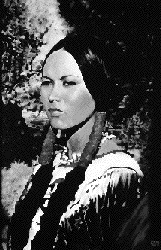
Painting: Indian Princess by Anthony Gruerio

FEDRA LIVE AT THE ROMAN THEATRE IN MÉRIDA, ESPANA


13 July 2007 –Val and I took the bus from Madrid to Mérida to see Fedra, yet another adaptation of the twisted, tragic Greek love story about a woman (Fedra) who madly adores her stepson, Hippolytus (Fran Perea), an unrequited love, the outcome of which dooms Hippolytus to death. Playwright: Juan Mayorga. Director: José Carlos Plaza. Ana Belén, a truly talented singing star born in Madrid, plays the sexy, unhinged Fedra with adroit skill.

The spectacle of a modern production in an ancient Roman theatre was one of the highlights of my UNO playwriting residency this summer. (the other: the reading of my play, Graffiti, at Chaminade in Madrid). Even sitting on sharp rocks in the top row of slave seats didn’t bother too much, especially since we’d been warned and had come prepared with seat cushions. (Me & Val)

Agrippa built this Teatro Romano in 18 B.C.E.. Mérida was founded as a Roman outpost circa 25 B.C.E.; commissioned by the Emperor Augustus from whom the name of the city, Emérita Augusta, was taken.

Except for the ice in the drinks at the bar, the venue does not offer much 21st century luxury. The show started at 11pm—to avoid the heat. The summer heat in Spain immobilized my body, a draining, dry, insidious heat. Just to keep moving, I was forced, at times, to drink copious amounts of refreshing tinto de verano, a mixture of red wine, and something like 7-up with the all-important ice.

Since I am familiar with Euripides’s story (428 BC) about the lustful Phaedra titled, Hippolytus, I was able to follow along with the plot, all in Spanish. Through the ages the story has been retold by Seneca, Racine, and the bilbaíno, Unamuno. But this version, premiered at the Classical Theater Festival of Merida, was obviously written for Belén—long, longggg monologues. In truth, the other main characters had their time in the spot, but Belén owned center stage. However, in conversing with an educated male of Mexican/American heritage, I was impressed with his confession, “the performance brought tears to my eyes.” Belén’s numerous, long soliloquies didn’t ruin the drama for him.

Since Mayorga won the National Theater Award last month for Fedra, and received 30,000 euros from the Ministry of Culture, the play, and most definitely Belén struck a chord in the hearts of many. But even Mayorga admitted, “It has been said that I have written this work for Ana Belén, […], but it is not true.” The “author” doth protest too much.
Fedra Review

Regardless, the production and set stunned me with the extraordinary mix of ancient and modern. A large red rectangular (or trapezoid?) shaped backdrop was placed upstage dwarfing the actors and used as a prop from time to time, to lean on, crouch next to, and so on, and a diagonal line cut into it illuminated with a laser light during intense moments.

The stage lights were strategically placed to highlight the various headless statues and half-ruined columns, and the excellent surround music track of eerie voices, coupled with occasional fog, added depth to the sword fight and tragic end. Bravo!!! The crowd wildly applauded during curtain call and rewarded the cast with a vibrant standing ovation–a welcomed event for me after sitting two hours on rocks (cushion notwithstanding). The pageantry of the event overwhelmingly carried the night.

The theatre seats about 6000 and the adjacent amphitheatre could have held 15,000 on a good day in the province of Augusta Emerita. Other productions at the 2007 festival: The Persas, Lisístrata, Adiós, Brother Cruel, Andrómaca, The Banquet of Orfeo, The Troyanas, Metamorphoses, , Orestíada, Antígona, Orión, & Electra.

The next day Val and I toured the relic of an amphitheatre adjacent to the theatre, where many gladiators and animals met their bloody death to entertain the local population; obviously one, if not the ancestral origin of the bullfight staged in Spain today.