All posts by Conrad Reeder

Unknown's avatar

About Conrad Reeder

B.A., M.F.A. Film, Theater & Communication Arts. Creative Writing: Playwriting. Lecturer at the University of Hawaii. Adjunct Faculty at Palm Beach State College. Currently working on a Ph. D. in Mythological Studies with Depth Psychology at Pacifica Graduate Institute. https://www.facebook.com/Graffititheplay :: Graffiti, a new play about Goldie and Alice, neighbors who live in a trailer park in Holiday, Florida, and fight about Junior, the grandson Goldie raised. Junior is now a man, and Alice has noticed.

GODDESSES, WHORES, WIVES, & SLAVES: The Archetypal Roles Assigned to Women in Theatre. Part 2: Women Write Plays, Too!


Euripides’ Medea (431 B.C.E.) does not go gently into the night, and some of her lines are the first uttered on a public stage in the defense of women.

Then they also say that whilst we live quietly and without any danger at home, the men go off to war. Wrong! One birth alone is worse than three times in the battlefield behind a shield (lines, 248-49).


The only notorious female writer of this ancient time in any genre is Sappho born about 612 B.C.E. and all that remains of her work is a single poem and fragments of others. In antiquity, Sappho was commonly regarded as one of the greatest lyric poets. An epigram in the Anthologia Palatina (9,506) ascribed to Plato says, “Some say the Muses are nine: how careless! / Look, there’s Sappho too, from Lesbos, the tenth” (Campbell, D.A.)


Sappho’s alleged bi-sexuality alluded to in the few remaining fragments of her poetry offended people throughout history; her books burned by Christians in the year 380 C.E. at the instigation of Pope Gregory Nazianzen. Another book burning in the year 1073 C.E. by Pope Gregory VII may have wiped out any remaining trace of Sappho’s works (duBois).

It’s been a slow crawl from a woman’s pen to the page to the public stage. Virtually no female playwright appeared in the West until the 10th century C.E. German Benedictine nun known as Roswitha or Hrotsvit von Ganderwhelm (Case 533). Roswitha penned six plays that are extant, following the form of the lax moral comedic plays by the 2nd century C.E. Roman playwright, Terence, albeit framed with a stiff moral Catholic slant.

But the first woman to make a living as a popular dramatist in the West, and the first female playwright covered in this essay (and an undergraduate course I designed as part of my Masters Degree Thesis) is Aphra Behn (1640 – 1689), who wrote during the period of the English Restoration Theatre (1610-1710). Denounced by the American literary critic, Harold Bloom, as a fourth-rate playwright, Behn was nonetheless hailed by Virginia Woolf in A Room of One’s Own.

All women together, ought to let flowers fall upon the grave of Aphra Behn… for it was she who earned them the right to speak their minds.

Woolf believed Behn’s total career to be more important than any particular work produced. However, Behn’s work still gets staged. At a recent performance (2003) of The Rover in Oakland, the reviewer called Behn’s role reversal scheme “spirited and saucy” (Jones).

Behn, a former spy for Charles II, might have settled the argument with the first line from the Prologue of The Rover:

Wits, like Physicians, never can agree, / When of a different Society.

From this point forward, women slowly made inroads into the male-dominated theatre. After the Puritan shut down of theatres in London for a decade, the atmosphere in London at the reopening of the theatres after the Restoration (1660) was festive, and women appearing on the legitimate stage for the first time was not (I believe) coincidental with Behn’s debut as the first professional English female dramatist.

Women seized the moment: Hannah Cowley, Susannah Rowson, Susan Glaspell (Pulitzer Winner), Sophie Treadwell, Lillian Hellman, Gertrude Stein, Wendy Wasserstein (Pulitzer Winner), Caryl Churchill, Ntozake Shange, Marsha Norman, Emily Mann, Margaret Edson, Alice Childress, Adrienne Kennedy, Megan Terry, Theresa Rebeck, Beth Henley(Pulitzer Winner), Sarah Kane, Caridad Svitch, Lorraine Hansberry, Maria Irene Fornés, Marsha Norman (Pulitzer Winner), Wakako Yamauchi, Spiderwoman Theatre (Native American), and many more have all contributed to the growth of Western theatre since Behn broke the all-male rule.

Another radical playwright vilified and adored in her own time was Mae West (1892-1980).

Middle and upper class white women generally dominated the women’s movement, one that would have certainly disapproved of Mae (Watts 106).

Exclusion of West’s plays from Murphy’s Cambridge anthology about women playwrights has much to do with critical readings of her plays, but I would argue that who or what she represented to the general public—-an independent, sensual woman who maintained a Goddess Archetype in spite of her Whore behavior, seized the same sexual freedom for women as men had always enjoyed. This was an unconventional Archetype for mortal women, as ground-breaking in society at large as the right to vote was empowering.

These days the discussion of West’s first hit play titled, Sex, (which has no sex in it) should be an enlightening experience for young people in the twenty-first century who have been sexually saturated by society and the media.
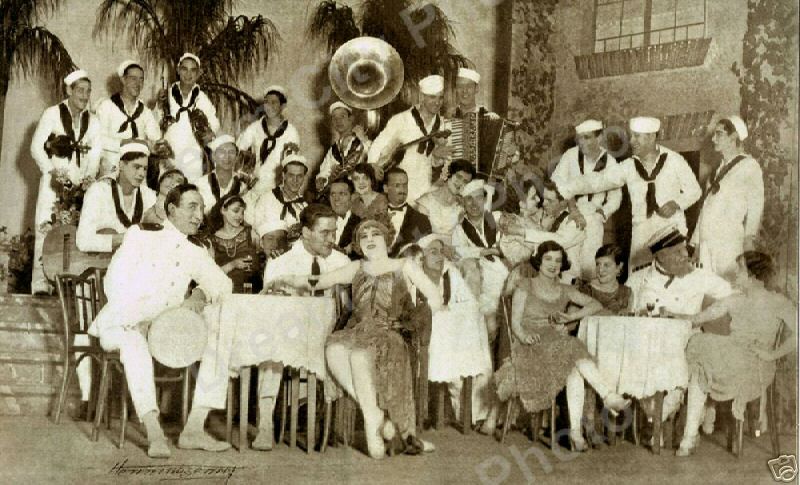
(West & Cast of her Broadway show, Sex (1926)

The Westian use of double and triple entendre to convey sexual images is a refreshing study in form and dialogue. No playwright before West had ever done this.

“attacked respectable women from the stage… of being whore(s) in disguise” (Schlissel 9).

West also opened the closet for the gays of New York City with her play, The Drag, which earned her jail time for her effort. In 1927, gays were the victims of viscous beatings by the New York City police. West was a major force behind legitimizing the gay subculture (Schlissel 11). Examining why West’s female brand of Archetype dominated the British/American stage and Hollywood movies for decades and during a depression era has merit in any study of plays by and about women. By designing her own unique Whore/Goddess that rejected male domination, West, a working class woman, offered “an early feminist role model” (Watts 107) whether certain feminists like it or not.

And then there is Suzan-Lori Parks.
Her play Venus exposed the vicious true story of the evil treatment of Saartjie Baartman, an African woman who was displayed in Europe (1789-1815) as a freak show because of her unusual buttocks.
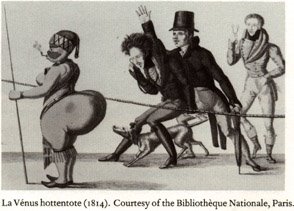

This Hottentot Venus is a Goddess/Virgin defiled and reassigned the role of Slave, and then Whore. The slavic safety of domesticity is not an option for this woman. Parks satirizes the insanity of it all by using a Greek Chorus, a harkening back to a time when women were banned from theatre, just as Baartman is banned from life.

Parks is the Goddess Archetype in her own life drama–the story of the first African American woman to win the Pulitzer Prize for Drama (2002) with her play, Topdog/Underdog; a play with only two characters—two male characters.

The boundaries of sex no longer apply. Women playwrights have joined their Archetypes center stage.
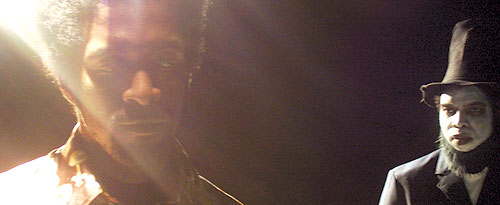

(Piccolo Spoleto theatre production of Topdog/Underdog, Charleston, S.C. 2006. Pic & article found here.

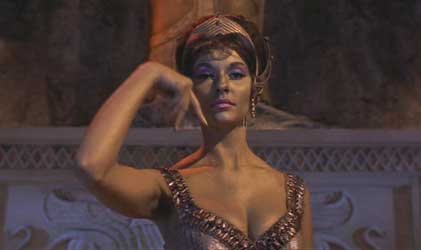
*Nancy Novak as Medea in Jason and the Argonauts (1963)

Works Referred To: Go to Part 1 of this essay.

Note: This essay is the introduction to an undergraduate class in Theatre History.

GODDESSES, WHORES, WIVES, & SLAVES: The Archetypal Roles Assigned to Women in Theatre PART 1

Plays by women and the roles for women in theatre represent a developing, dynamic field–historically, a much neglected field. If women wrote throughout recorded ancient history, most of it never saw the light of day, or was lost, if not systematically destroyed.

Based on the available evidence, the origins of Western theatre began in ancient Greece. Susan Pomeroy asks in her book, Goddesses, Whores, Wives, and Slaves, “What were women doing…” during this period (xiv)? Were the classical male playwrights accurate in their depiction of women (93)? There is no evidence showing that women were even allowed to attend the ancient dramatic festivals (80). Men portrayed women onstage until the seventeenth-century C.E.. What, if anything, did women actually write for theatre throughout recorded history?

Pomeroy also asks, “If respectable Athenian women were secluded and silent, how are we to account for the forceful heroines of tragedy and comedy”(93)? The simplest answer may be the best; men wrote these stories, promoting and perpetuating the most dramatic and entertaining archetypes from their cultural religion. Greek women may have been sequestered, but Greek Goddesses, like Athena, the Goddess of War and Wisdom were not.

Joseph Campbell (1904-1987), the renowned mythologist, defined archetype as follows:
They (archetypes) are elementary ideas, what could be called ground ideas.

These ideas Jung spoke of as archetypes of the unconscious. The Freudian unconscious is a personal unconscious, it is biographical. The Jungian archetypes of the unconscious are biological. The biographical is secondary to that.

All over the world and at different times of human history, these archetypes, or elementary ideas, have appeared in different costumes. The differences in the costumes are the results of environment and historical conditions (Campbell 61).

For this discussion the term “Virgin” signifies an Archetype with a valuable commodity traded in society, as well as a sexual state. Most of the Goddesses of myth enjoyed lusty sex, so in this context the title of Goddess signifies a woman who can decide her own fate. The only power earthbound women held until recent history resided in their “Virgin” state, and the brokering ability this virginity gave them through the men who manipulated them. The prostitute was the exception. Prostitutes were historically the only women who exercised control over their own money (Pomeroy 91), but this was a power only fit for a life in the shadows.

Throughout recorded history prostitution was one of the very few positions open to women. Playwrights, male and female, have used the role of “Whore” with dramatic effect. Art mixes with life, and dramatists have painted the Whore/Mistress as a hapless character in soap-opera stories played out in every village and town from ancient history up to now, as recent events surrounding New York Governor Spitzer will attest, but the Whore can also have power and influence history making events. The famous courtesan, Aspasia, was vilified by later writers for influencing the Greek General Pericles of Peloponnesian War fame in the 5th century B.C.E.. Madame Pompadour exchanged sex, then companionship with married King Louis XV (1710-1774) for titles and funding, but she was the one blamed for the disastrous Seven Year War, not the King or Queen. The Whore is always the convenient scapegoat.

Although being a prostitute meant a woman without other means could survive, it also generally meant being subjected to societal scorn and ridicule, after all, prostitutes had no real authority to object otherwise. Playwrights generally left the whore in the dust. Even the rebel Aphra Behn leaves her character, Angelica, the prostitute in The Rover, unmarried and unsupported. Angelica sums up her ending with, “He’s gone, and in this Ague of My Soul/ The shivering Fit returns” (Behn 74). Until recent history, men have not traditionally been excoriated in text or in life for having extra-marital sex (Garton).

The Wife Archetype portrayed social respectability, a role that centered around the affairs of domesticity and childrearing. In the lower classes (even today) the role of wife was (and is) synonymous with that of a slave worker. Ask any working wife trying to raise a family with a lower income about her life.

Historically, playwrights often used the role of slave or servant to ridicule the upper classes and speak to the heart of the matter i.e. in Aphra Behn’s, The Rover (1677), it is the servant Moretta that quips to the roguish Cavalier, “Your Linen stinks of the gun room” (35).

Reducing the sum of assigned roles/archetypes to women as “Goddesses, Whores, Wives, and Slaves” catalogues broad categories that reflect the female stock characters on stage and in life. By scrutinizing how playwrights in the West and elsewhere have used these archetypes throughout recorded history, the next extrapolation would suggest Goddess/Virgin, Whore/Sex-No-Marriage, Wife/Married, and Slave/Worker.

With ancient texts labeling women as the “root of all evil” (Kramer & Moore), it would seem that a discussion about women and their role in theatre should begin with an examination of language, segueing to a look at Euripides’ Medea, as an early example of Greek theatre to kick-off the discussion.

According to the earliest (male) writers of Greek antiquity, the Muses were goddesses of song and prophecy. They lived on Mount Helicon in Boeotia. The exact number of Muses and their parentage varies from source to source. Early on, there were three of them. Some claim that they were the children of Mnemosyne (memory), one of the few Titan relatives Zeus favored and found useful. The popular Greek poet Hesiod (7th century B.C.E.) was the first to name nine muses—all female. Later writers assigned them to nine branches of literature, art, and science (James).

The Musae

Erato – Erotic poetry
Urania – Astronomy
Polymnia – Sublime hymn
Melpomene – Tragedy
Euterpe – Lyric poetry
Thalia – Comedy and idyllic poetry
Calliope – Epic poetry
Clio – History
Terpsichore – Choral song and dance

It would seem from this that women were prominent in the original scheme of things, based on key positions of deity and power, but certain early male writers took umbrage as to why women even existed. Theories abound. One currently circulates that the act of writing and reading somehow rewired our brains, splitting the sexes into a power struggle that literate societies continue to wage. Non-literate aboriginal societies have typically not vilified women (Schlain).

Pomeroy suggests the advent of the city-state (polis) advanced a culture ruled by laws and courts, instead of tribal law. This city-state evolved outside of the home. This new realm of men excluded women whose realm of influence remained inside the walls of the home. “Misogyny was born of fear of women. It spawned the ideology of male superiority” (Pomeroy 97). Since records are sparse, historical context might be missing, but misogynistic examples are numerous in ancient texts, including the above mentioned Hesiod, who wrote in his Theogony that “Zeus who thunders on high made women to be an evil to mortal men, with a nature to do evil” (590-93).

One wonders if Hesiod was working off his angst after being jilted in love when he wrote that, but the Judaic canon written roughly about the same time corroborates the stiff sentiment with “in sorrow dost thou bear children, and toward thy husband [is] thy desire, and he doth rule over thee” (Genesis 3:16). Even Thomas Aquinas (1225-1274), the angelic doctor, refers to women as “defective and misbegotten” (Kramer).

Euripides’ Jason in Medea (431 B.C.E.) laments, “Life would be better without women if men could get children any other way” (564), and that was before Jason’s ex-wife, Medea, killed Jason’s virginal bride, the bride’s father, and his two young sons with Medea. Earlier versions of the Medea myth implicated an apparent unintentional killing of the children by the sorceress Medea during a ceremony to immortalize her sons. Another story blamed the Corinthians for killing the boys after Medea fled. Robert Graves catalogued the story about Euripides being bribed by Corinthian businessmen “with fifteen talents of silver to absolve them of guilt” (Graves 617).

Euripides upped the stakes by having Medea commit infanticide, which more than muddles the crimes committed by Jason. A mother killing her children betrays the most basic human interaction and therein the foundation of civic society.

It seems a girl can’t get a break from certain ancient writers.

PART 2: Next Week. Women Write, Too!

WORK REFERRED TO

Behn, Aphra. The Rover. com. by Bill Naismith. GB: Methuen Drama, 1993.

Brockett, Oscar G. and Franklin J. Hildy. History of the Theatre. 9th ed. Boston: Allyn & Bacon, 2003.

Campbell, Joseph with Bill Moyers. The Power of Myth. New York: Doubleday, 1991.

Case, Sue-Ellen. “Re-Viewing Hrotsvit.” Theatre Journal, Vol.35:4. Dec. 1983 533-42. http://www.jstor.org 8 Feb 2008

duBois, Page. Sappho Is Burning. Chicago: UCP, 1995.

Garton, Stephen. Histories of Sexuality: antiquity to sexual revolution. New York: Routledge, 2004.

Graves, Robert. The Greek Myths: Complete Edition. London: Penguin Group, 1960.

James, Vanessa. The Genealogy of Greek Mythology. New York: Penguin Group, 2003.

Jung, Carl G. The Portable Jung. Ed. Joseph Campbell. New York: Penguin Group, 1976.

Korzybski, Alfred. Science and Sanity. 5th Ed. New York: Inst. General Semantics, 1994.

Kramer, Daniel & Moore, Michael. “Women are the root of All Evil: The Misogyny of Religions.” Secular Web Modern Library 17 pp. 2002. http://secweb.infidels.org/?kiosk=articles&id=203 30 March 2008

May, Rollo. The Courage To Create. New York: Norton, 1994.

Murphy, Brenda, ed. American Women Playwrights. UK: Cambridge UP, 1999.

McDermott, Emily. Euripides’ Medea: The Incarnation of Disorder. USA: Penn State U., 1989.

Partnow, Elaine T. with Lesley Anne Hyatt. The Female Dramatist. New York: Facts On File, 1998.

Pomeroy, Sarah B. Goddesses, Whores, Wives and Slaves: Women in Classical Antiquity. New York: Schocken, 1995.

Schlissel, Lillian. Three Plays by Mae West: Sex, The Drag and Pleasure Man. New York: Routledge, 1997.

Shlain, Leonard. The Alphabet Versus the Goddess: The Conflict Between Word and Image. New York: Viking Penguin, 1998.

Theatre Theory Theatre: The Major Critical Texts from Aristotle and Zeami to Soyinka and Havel. Ed. Daniel Gerould. New York: Applause, 2000.

Watts, Jill. Mae West: An icon in Black and White. New York: Oxford UP, 2003.

Women writing Latin: from Roman antiquity to early modern Europe
. Ed. Churchill, Laurie J.; Brown, Phyllis R.; Jeffrey, Jane E.. New York: Routledge, 2002.

Woolf, Virginia. A Room of One’s Own.
http://ebooks.adelaide.edu.au/w/woolf/virginia/w91r/complete.html 8 Feb 2008.

© 2008 Conrad Reeder All Rights Reserved

WHAT DO ANN BOLEYN & WEETAMOO HAVE IN COMMON?

What do Anne Boleyn and Weetamoo of Colonial New England have in common? They were both Queens and both had their heads chopped off.


The Captive
presents the story of Weetamoo, a Native American Queen in 17th century New England, who led her Pocasset braves (the ones who survived the scourge of European diseases) in battle against the invading English and their Native Allies during King Philip’s War (1675-76). The Colonial Army was organized under the auspices of the United Colonies, a body formed to combat Natives that evolved into an enduring institution, eventually challenging their overlord, the British Crown, a hundred years later in the American Revolution.

King Philip’s War (Metacom) was the last concerted effort of coastal northeast Woodland Nations to expel the English, in particular the Puritans, and they nearly succeeded. This singular event ignited a firestorm that swept over the entire North American Continent, annihilating ancient cultures, entire eco systems, and the animals they supported. For eleven weeks and five days in early 1676, when a Confederation victory was not assured, Mary Rowlandson, a Puritan Preacher’s wife, was Weetamoo’s slave.

This true encounter has been brought to life on stage in context with the events of their time. The metaphorical story of Annie and Joshua gives voice to the dispossessed. Musical instruments, period songs, and dialogue lifted from historic journals all combine with the thrill of spectacle into a dramatic play in two acts: THE CAPTIVE

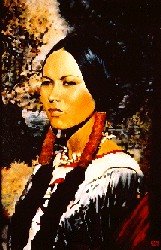
Painting: Indian Princess by Anthony Gruerio

THE CAPTIVE MIND: THEN AND NOW: PART 2

IT SEEMS CAPTIVE MINDS WORKING TOGETHER CAN WIN WARS, build towns and universities, but at what cost to humanity and the environment? And is it worth that cost?

The Mayflower Compact, deemed by some as one of the documents that inspired the U.S. Constitution, came from a “people who had more in common with a cult than a democratic society” (Philbrick 40). These days, 21st Century Puritans and their allies offer the gift of a “safe” society, a gift I seriously doubt they can deliver.

ON TOP OF THAT, A PURITAN SOCIETY charges a hefty price then and now. Literature, music, science, art, freedom of thought or speech, invention; all suffer in a society dominated by captive minds (check out Cromwell’s England—no laughing matter). Like Mary said, “Mine eyes have seen it”—mine, too.

My journey to escape my captive mind began around the age of eighteen. I had moved away from home with my (now ex) husband, who had left college to join the Army, into the vast and howling wilderness of Army life. Luckily, I attended a local college near the base that was concerned with education, not biblical dogma, and I started reading books called literature, but more importantly, I stopped going to church. There is a reason backsliding is attacked vehemently from the pulpit. In order for the mind to stay captive, a constant flow of dogma must be administered. Ballet, theater, literature, wine, films, meditation on the inner light we all share, and all holidays, religious or otherwise—I enjoy with gusto—daily reminders of the rich culture I almost missed out on. Oh, and I wear a bathing suit in front of men, and enjoy (God forbid) sex.

After thinking about this a lot, ( I WROTE A PLAY ABOUT WEETAMOO AND MARY ) I wonder if Mary would have been more receptive to the Native People around her without the physical Bible in her hand, nourishing the mustard seeds of dogma grown as big as oak trees in her head?

“I repaired under these thoughts to my Bible (my great comfort in that time)” (Lincoln 137). As soon as I had an opportunity, I took my Bible to read, (Lincoln 139). I was turning the leaves of my Bible, and the Lord brought to me some Scriptures, which did a little revive me (Lincoln 142). “I had time and liberty again to look into my Bible: Which was my Guid [sic] by day, and my Pillow by night” (Lincoln 144).

Time and time again Mary buried her face in the Bible to escape the tangible world. Granted, the poor woman deserved some respite, but why block all sensible feelings?

Mary refused to acknowledge that the kindness and “common mercies” shown to her many times during her ordeal came from people who were suffering greatly themselves. It was a sympathetic Native that gave her the Bible in the first place. In Mary’s captive mind these friendly Natives were only agents of the “goodness of God,” not free-agents acting out of the kindness they felt in their human hearts (Strong 101). The material world was strange, and the people in it were strangers. Ralph Waldo Emerson said, “I believe in the existence of the material world as the expression of the spiritual…the laws of both are one” (Dillaway 33).

Puritan Mary didn’t see it that way. The singular expression of the spiritual for her came from pulpit-fed perceptions—reinforced daily by the Bible she held in her hand. Only a savage heathen would like living in a material world of “vanities” in the “vast and howling wilderness ” (Lincoln 163). The Bible was the software running the captivity program in Mary’s mind.

Yes, Mary was wronged by the Natives-—her daughter and others were killed, but why did Mary feel she deserved this suffering? “Affliction I wanted, and affliction I had” (Lincoln 142). How sadomasochistic is that? The Natives living in 17th century New England, of course, had many reasons to be angry and vengeful. Their lives had been turned upside down: their land stolen, their people killed and worse–sold into slavery. Native People who lived through the European encounter suffered unimaginable loss.

Weetamoo and her allies may have briefly captured Mary, and done her physical harm, but Weetamoo’s entire world was annihilated by the onslaught of Puritan emigrants greedy for land. Had the Natives of New England worked together, King Philip’s War might have ended differently, changing the course of history, or at least some of history. In the spring of 1676, the Natives nearly drove the “English to the very edge of the sea” (Philbrick 302). Although outnumbered, the Natives were better shots, and maneuvered easily through the environment, unlike the clumsy English farmers unfamiliar with skulking warfare.

The irony is Mary Rowlandson, a Puritan preacher’s wife, and Weetamoo, Queen of Pocasset, were both captives. Weetamoo was a captive to exterior events that spun out of her control and Mary was a captive in her own mind.

If we exist because we think, THEN AS NOW, the struggle to think clearly continues…

WORKS CITED

Dillaway, Newton, ed. The Gospel of Emerson. Mass: The Montrose P, 1949.

Winthrop, John. “On Liberty.” 1645. Constitution Society.5 Aug 2008 http://www.constitution.org/

Lincoln, Charles H., ed. Narratives of the Indian Wars 1675 – 1699. New York: Scribner’s Sons, 1913.

Mather, Increase. A Brief History of the Warr with the Indians in New-England (1676). Ed. Paul Royster. Nebraska: U of Nebraska, 2006. 8 Aug 08

Page, Jake. In The Hands of the Great Spirit: The 20,000 -Year History of American Indians. USA: Free Press, 2003.

Philbrick, Nathaniel. Mayflower: A Story of Courage, Community, and War. USA: Penguin, 2007.

Strong, Pauline Turner. Captive Selves, Captivating Others: The Politics and Poetics of Colonial American Captivity Narratives. USA: Westview P, 1999.

More information and links: http://www.conradreeder.com/TheCaptive.htm

Conrad “Connie” Reeder was born in Columbus, Ohio, and recently graduated from the University of New Orleans with a MFA in Film, Theater, & Communication Arts with a concentration in Playwriting.

The Captive is a dramatic play in two acts.

Contact: conradreeder@gmail.com

© All Rights Reserved

THANK GOD FOR KEITH!

Bless everyone’s hearts on this day of infamy. Shame on any politician who uses this tragedy for a campaign slogan. Shame on the politicians and their backers who used it for financial gain and perceived power.

I repeat, like Keith and a host of others, THE REPUBLICANS WERE IN CHARGE ON THIS DAY IN 2001. Why are they in office? Not only does the King have no clothes, the King has no conscious, no moral ground to stand on, and no credibility with anyone that has eyes to see, ears to hear, a brain to think, and a heart to feel.

MYTH AGAIN!

HELL, it’s all too easy for some moderns to look at Greek, Inuit, Hindu, Viking, or anyone else’s myths and dismiss their stories as the workings of unsophisticated minds. What I got from my Latin class in High School was a validation for believing in the superiority of my beliefs. After all, Venus was the Goddess in a mythical pagan pantheon and Jesus, the Son of God, a historical fact. To step out of one’s own myth and scrutinize it with equal veracity is not something I would recommend for the feint of heart.

My stepping-out started in college. Having moved away from my family to another state, I found myself going to church less and less. I knew this back-sliding was not acceptable in my circle, but things had started to unravel in my thinking. Ideas were fomenting my brain i.e. General Sherman was not as revered as I’d been led to think by the North American history book used in the public school I attended (I have a gr-grandfather who was in Sherman’s Ohio army and my college was in TN), OR the planet might be older than the 6,012 years I was taught in Bible School as fact, OR could it be the Garden of Eden story was just another myth like Pygmalion and Galatea?


During this period a trippy event happened to me, while sleeping soundly in bed one Sunday morning. A large clap of thunder vibrated my dwelling, and I nearly convulsed onto the floor. My body seemed to have a mind of its own. Lightening was not the culprit. Fear shook my bones. I was afraid of being cast into the fiery pit of Hell for all of eternity. My entire being felt the second coming of Christ and the onset of Judgement Day. A hologram of the event appeared all around me in living color with fiery dragons and seven-headed beasts. Withdrawal is rarely a smooth transition—and this was B.D.E. (Before Drug Experimentation). Somehow I survived this crash. Working as an actress on stage at the time helped me navigate this adventure. In the process of analyzing and portraying another person, I started to analyze myself–an ongoing process to this day 🙂

Along the way I decided to search for the root of this addiction to myth, and not fall into the trap of replacing the big hole in my heart and brain with more useless babble, or mind numbing addictions. (OK I admit it – I’m addicted to coffee and sugar) Some in my current circle might say I took up with Juno. “If I cannot sway the Gods above, I’ll stir up Hell.” (Virgil – Aeneid, VII.312).

All this led me to Mary, who represents the female aspect missing or maligned in the Jesus story. For all the arguments about how inclusive Christianity is, I have yet to see it realized in any society or historical events.

I regret not getting more of my writing in print before the media splash of The Da Vinci Code, so as to seem more of a leader than a follower (my hero journey), but que sera sera…

Utor Mens!

I SPEAK FOR THE DEAD

I speak for dead people—some with real historical lives that can be read about in books and some who only live in my head, but I hear them speak. Just because people are dead doesn’t mean they never existed. Just because people are dead doesn’t mean they don’t have a story.

The challenge for this writer is to portray these people as authentically as possible, a daunting challenge at best. Sometimes the facts of their story have been written down, at least some of the facts. As any writer or reader knows, sometimes there are big holes in the facts of someone’s story. How they thought and felt is another matter. Even writing what I think and feel about my own life can be a mission sometimes, at least in a way that others will feel compelled to read it. Throughout history, I bet people who journaled felt the same pressure, at least the ones hoping to publish–very tricky this stuff of portraying a story, anybody’s story. And what about the one’s who didn’t journal? Who speaks for them, especially when someone else tells their story and gets even the facts wrong?

How can I explain my need to write the words of the dead? The Trickster enters into my stomach (through a process I don’t entirely understand) and creates this “havoc” or a “gut feeling,” and away I go. I start hearing dead people talk. Dead does not mean silent, as long as there is someone to hear them and type down what they say (I hardly write anymore, my hand hurts). So, I hear it, and I type it. Whether or not the dead are happy about this, I have no idea. They haven’t said one way or the other, but they keep talking, and as long as they’re talking, I’ll keep listening, and typing, speaking for the dead, as best I can.

Then there’s music, I hear that, too. But that’s another story…

Green (my addition) Dragon from the 13th century Southern Song Dynasty.
Trickster, is that you?

And Happy Birthday to my daughter Ashlee! What a story she will tell…