Category Archives: Uncategorized

The Intersection of Ritual and Consciousness

Are Mystical Religions a Fifth Dimension?

Oshen

DETERMINING THE NATURE of an ecstatic experience during the ritual of any mystical religion seems subjective and unreachable. But some common parallels in these rituals do exist with a broad stroke.

Disclaimer: I have visited Cuba, published about Cuba (EQ 1999)
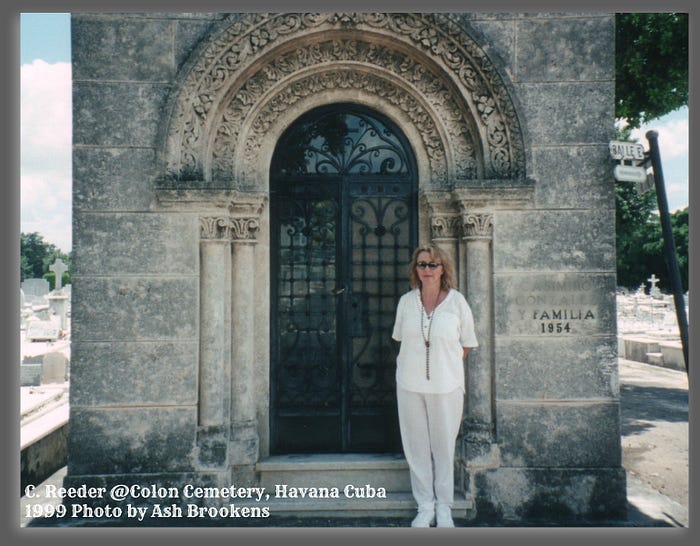
Author @ the Colon Cemetery, Havana Cuba 1999

and lived years in Miami, NYC and New Orleans, cities with large numbers of Afro-Caribbean people. I’ve also been exposed to some of the Santería/Vodoun rituals and icons, but I cannot speak in the first person about Santería possession or trance. However, credible authors such as Maya Deren and Joseph Murphy shared their close experiences with possession, providing a small window.
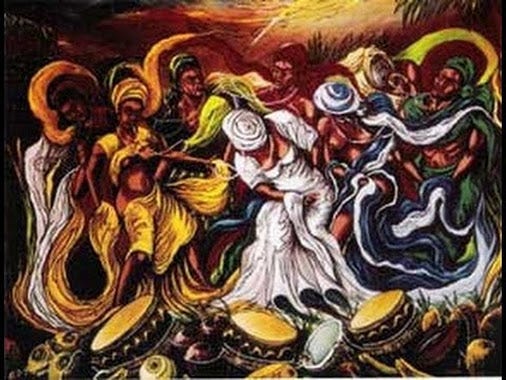
7 African Powers

Are metaphysical encounters, ritualistic or otherwise, merely the by-product of brain synopsis or is there a region outside of our solid awareness, a dimension that our bodily senses cannot easily detect, and could this region be shared by all humans, a realm in which any person from any race or ethnicity can access under the right circumstances?

The religion of Santería or the way of the saints, also called Regla de Ocha, was constructed by West African priests/priestesses kidnapped by slavers, since among many other similarities, the liturgical language is a dialect of Yoruba or Lucumí, a language of West Africa, specifically Nigeria. (1) In the Caribbean, the African religion hid behind the saints inside the Catholic Church foisted on the slaves. Enslaved Africans noted the similarities of their native gods or orishas from their African homeland with that of the Catholic Saints.

The orishas were paired (hidden) behind their Catholic counterparts. Elegguá embodies St. Anthony — fate and justice; Orúla embodies St. Francis of Assisi — divination or wisdom; Changó or Shangó embodies St. Barbara — passion or power or thunder; and Oshún embodies Our Lady of Charity or Caridad (Cuba) — eros or love, marriage and gold. Each orisha is associated with its own color and number.

Oshún’s Altar

For example, Oshún’s color is yellow and responds to the number five (Murphy 43). Africans in slavery kept their Orishas alive in their hearts and minds, along with their ancestor rituals, which are seemingly the foundational rituals. According to one Santeria church, “if we stand tall it is because we stand on the shoulders of our ancestors and are reaching for the orishas.”

Joseph Campbell talks about a “fifth dimension” where people experience a bliss or “Earthly Paradise,” even though in the physical world this same blissful person may seem to another observer as “a squalid heathen in a shattered hut” (Deren xii). So, it is all about perception, once again: personal space or fifth dimension? (The vote is out as to whether there is even a 4th dimension, so beware of anyone with so-called facts.) And, where is this other, extra-dimensional space, next to our own or is it simply in our heads, in a room of our own personal space? Whether or not a god appears in this “fifth dimension,” incorporating separately from human consciousness, is entirely another, improvable matter to the scientific community that demands a tangible proof untenable to measure with current technology.

The other choices in this dithering around the sacred are the obvious sneers from the peanut gallery: drugs or hallucinogens. Yes, maybe some, but not all, not even close.

Recent research in the field of DNA genetics, specifically mtDNA, the mitochondrial DNA passed down through the mother, reveals what archaeology has failed to prove, that the human species most likely originated out of Africa, and our ancestral Eve lived around 150,000 years ago; “the oldest genetic lineages are found in people living in central and southern Africa” (Wells 40). If the bodily DNA of all humanity is the same, why wouldn’t the unconscious realm be similar, as well?
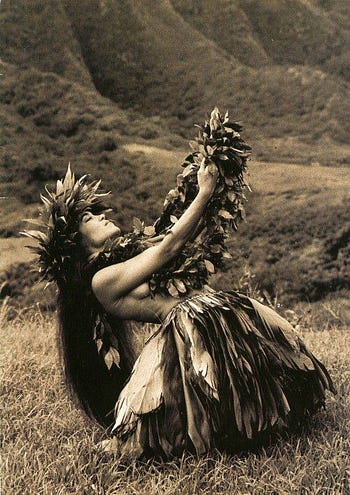
Hula Kahiko (ancient style)

Trance-like ceremonies happen all over the world in all types of religions. In Hawaii the ecstatic nature of the Fire Dance invokes the Volcano Goddess Pele to enter the body and give the dancer or chanter strength, energy and creative ideas. Participants of Pele fire rituals experience a “fullness of knowing that the gods of Hawai’i are never so far off that we cannot see their faces, or hear their thoughts, or feel their breath on our necks” (Tangaro xxiv).

One of the biggest exports of India is their culture of possession by Shakti — a snaky Goddess of energy that invades or revives the body, depending on the slant.

Kundalini Energy

Shakti theoretically awakens the sleeping energy of kundalini, a corporal energy situated at the base of the spine, which then enlivens the chakras (energy points) placed at various points along the spine/body and out the top of the head.

Meditation Kriyas

In Shakti chants, I have personally witnessed and experienced frenzied bodily movements (kriyas) where the body moves without a conscious effort on the part of the owner, real-life moments of an awareness that does not exist in the physical plane, but in some construct of mind or consciousness, the intangible arenas that are as real (to my mind) as the chair I’m sitting in.

In my own experience, I did not invite or expect an explosion in my stomach, which then traveled up through my spine and out the top of my head or the events that happened thereafter. When I spoke of these events to a swami at the ashram, I expected him to be surprised, as if this had never happened to anyone but me.

Instead, he casually explained it as a common occurrence or kriyas among people in the vicinity of a powerful guru, much like the loa jumping from one person to another — also, reminiscent of Deren’s story about “a man standing on the sidelines […] who keels over […] the loa can come like this, without warning, as a wind” (Deren 255). I wasn’t even in the ashram when my events or kriyas happened. I was reading a magazine article about this guru in the comfort of my home miles away.

Some of my genetic ancestors are from the Religious Society of Friends or Quakers. Derisively called Quakers, the word “quaker” is how outsiders described what the Friends did while meditating in silence, their way to personally receive the “indwelling Spirit of God” without the aid of a priest or ornamental ritual.
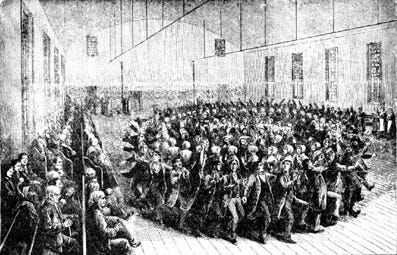
Shaker Dance

Considered devilish in 17th century England, the Quaker belief system incurred the wrath of the King, the Church of England and even The Puritans. (3) “Their intensity of focus sometimes resulted in involuntary physical quaking and weeping” (Larson 19). What these trancelike states have in common is that they are all altered-state experiences of the human mind — altered or theoretical, only in the sense that it is a mode of being that our current science cannot explain, or in some cases, even acknowledge as purposeful events. 

The physical bodies and psyches are affected in all these rituals.

Since humans share a common ancestor, it seems plausible that our mental maps, wherever they lead, may also share some similarities in our journey of the mind.

A Santero priest

For those who practice Santeria, “the trance opens the doors to spirit possession, and the gods, or orishas, briefly enter the trance-induced body and use it for earthly advising” (Gage). A sensitive person involved in the ritual dance propelled by the drums willingly becomes possessed or “mounted” on an orisha who can then communicate to the group or answer questions. While in this state the person does not look like himself and talks with the authority of the orisha, (4)“the animating force of his physical body” (Deren 16).

The Haitians have a saying, “When the anthropologist arrives, the gods depart” (Deren xvii), much like the old saying “a watched pot doesn’t boil.” And even though a watched pot does boil, there is a question of how we measure the time it takes to boil and that leads to the woo-woo world in science called quantum mechanics. Quantum mechanics can offer a way to think of these in-between states of circling gods or pre-boiling water, curious events that seem to be affected by the attention, maybe even intention of our thoughts.

I lack the 15 years of mathematics needed to even approach quantum mechanics, a scientific theory that defies the usual rational explanation, but I am not alone in this quantum conundrum. Richard Feynman, a nuclear physicist, famously said, “No one knows why it is that way. That’s just the way it is” (qtd. Sagan 249). Quantum mechanics research shows through repeated experiments that light (and therefore matter) is neither a wave nor a particle until the collapse and this prequel arena, the waiting area for a temporal existence for the light or matter, is what physicists call a state of complementarity.

In his analysis of the relationship between quantum physics (mechanics) and psychology, C. G. Jung noted the synchronicity, especially in the two fields sharing this aspect of complementarity, comparing the unconscious state of the mind before action in the body to the prequel state for matter/light, that arena of neither/nor. In this state of complementarity “the consciousness is once more isolated in its subjectivity” (qtd. in Romanyshyn 32).

Consciousness is a certainty. Without consciousness, there are no thoughts available to imagine objects and then manifest them in the real world. An architectural draft created in the mind of an architect becomes manifested in the material world with the building of a skyscraper from the draft. We know we have a consciousness, but without tools to measure it in the scientific method, we have no way to prove its existence other than the fact that we know we are thinking, just as I must think the word before I type it. Not typing the word does not mean I didn’t think the word. The word existed as a thought whether or not it exists as a word on a page.

But how do we determine if our thoughts are our own or that of another entity’s thoughts? And how do we prove that thought entities or deities exist without tools to measure them? One way may be to measure the affects on a known object, such as the way astronomers find planets, not by direct observation, but by using the “wobble method” as a way “to track the host star as it is tugged to and fro by the planet’s gravity” (Overbye).

If there is an entire field of science devoted to examining planets not visible to the naked eye, then why shouldn’t thoughtful people examine the possibility of a “fifth dimension” not visible to the naked eye, as well?

Dr. Amit Goswami

“In quantum physics, objects are not determined things — objects are possibilities. Possibilities of what? Possibilities for consciousness to choose from” (Goswami The Quantum Activist). Consider this: in the practice of Santería, the body is the object of a consciousness or an orisha and the body (light) as an object can be possessed by an orisha (wave) from somewhere (which I am arbitrarily calling a fifth dimension), or not possessed but experiencing something (a particle?) in her/his personal space triggered by ritual. The animating influence, whether that of the person animating himself or something “other” animating him in a “fifth dimension,” is an indeterminate by the current laws of science, but nonetheless, the possibility of this animating “other” from somewhere (a fifth dimension?) exists and the proof of that possibility is the affected body of the possessed person like the wobble of a host star.

In quantum mechanics’ experiments, the result of whether light becomes a wave or particle depends on the type of measuring device used, and by comparison, in Santería, the appearance of the gods or orishas depends on the type of measuring minds in attendance and the procedures taken to create the fertile ground to attract the orisha, such as the use of certain colors, candles, chants, rhythms, incantations etc., that are particular to the orisha the group wishes to invite.

For example, Erzúlie or Oshún, the goddess of love expects sacrifices of jewelry, perfume, sweet cakes and liqueurs, and is attracted by the colors gold, pink, blue and white. Philbert Armenteros, an Afro-Cuban musician and Santería practitioner believes the music is not enough to attract a deity, that “the full effect is more likely when all the right elements are present in a ceremony” including the aforementioned items, as well as, a spiritual Santería leader or babalawo” (Gage).
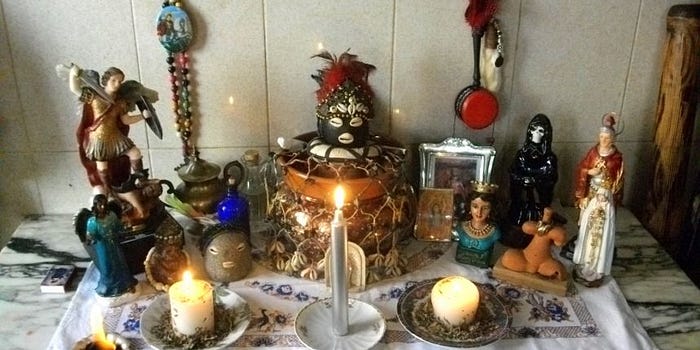
Santaría Altar

Even if it’s something from the “fifth dimension” is it a self-contained entity with a life of its own or is it an energy or color or wave or particle that inhabits a collective unconscious outlined by Jung as a second psychic system of a collective, universal, and impersonal nature,” (Jung, Archetypes 43).

The psychic contents or the orishas animating bodies in Santería rituals could be the inherited collective unconscious of the African experience.

During a Cuban bembe, a sacred style of drumming, Joseph Murphy, a scholar and Santería initiate witnessed a possession, “an altered state of consciousness both in the “horse” of the orisha and in the community in the orisha’s presence” (Murphy 165). “One woman in particular is carried by this energy […] Her eyes are closed, and she is whirling and whirling. […] she falls to the ground. {…} Her eyes are open now and gigantic, their focus open to the whole world. Her face is illuminated with an enormous smile, and she moves her shoulders and hips with sensuous confidence. Oshun has arrived” (96).

This woman had mounted the divine goddess, Oshun. She changed her clothes to gold trappings and moved around the crowd possessed with the mannerisms of the erotic goddess, blowing kisses and laughing. Murphy had already gone through weeks of initiation rites before the event and was very much a sympathetic observer and participant. He looked into the woman’s eyes and was “paralyzed.”

Oshun symbol.

Her sacred peacock.

He wrote “this is not a human being before me. It feels as though the drums are inside my head.” Murphy then experienced “strange sensations and deep calm […] and can see every slap of the drummer’s hands.” He was aware but not alarmed about his voice changing and the unfamiliar words he spoke — African words.

It seemed he had channeled the majestic orisha, Shango. Murphy hyperventilated, but his handlers blew in his ear and calmed him (97). He felt this was “the heart of the religion at last, a harmony of the human and divine in dance and joy” and called this “paradise,” but even after all that he stated “the people have brought the orishas out of themselves” (98) an indication that even after his own close encounter with the god, even then he can only be sure that it came from somewhere inside of himself, origins still unknown. The drum rhythms, the chanting and the dancing seem to be “directly conducive to the state of possession, suggesting the possibility of self-hypnosis as a precursor to the trance state (González-Wippler 8).

After the loa (vodoun) (5) or orisha left the body, the return to reality was accompanied with spasms or jerking movements, but in all the cases the return left the possessed with a new clarity. “How clear the world looks in this first total light” (Murphy 261) — “a call to a new reality” (98). This same description could be applied to an encounter with the angels of Christianity or those who are “born again.”

Depth Psychologist Carl Jung was convinced “the collective unconscious is common to all; it is the foundation of what the ancients called the ‘sympathy of all things’” (Jung, Memories 138). If the “fifth dimension” or the abode of the collective unconscious exists, the nature of this dimension, whether it is a shared area of complementarity, the area of pre-material existence in quantum mechanics or a doorway for unexplainable entities to interact with humans remains a mystery. These experiences of possession in African ritual are too ritualized, too similar, not only among their own African religions of origin, but also with many religious experiences around the world.

The African cosmos (and other rituals) may offer a gateway for studies in the new frontiers of metaphysical dimensions with or without the scientific method — hard for me to say since I’ve subscribed to skeptics.com since forever. Regardless, at the very least, the religions of Africa are a powerful tool. A people so abused, so tortured as African slaves survived unimaginable horrors with the help of this powerful, humanitarian tool: a mystical religion.

And so, I am happy to entertain these ideas and experience the joy of being in the company of a powerful, life-enhancing dynamic, especially with a seemingly golden goddess, either real or imaginary.
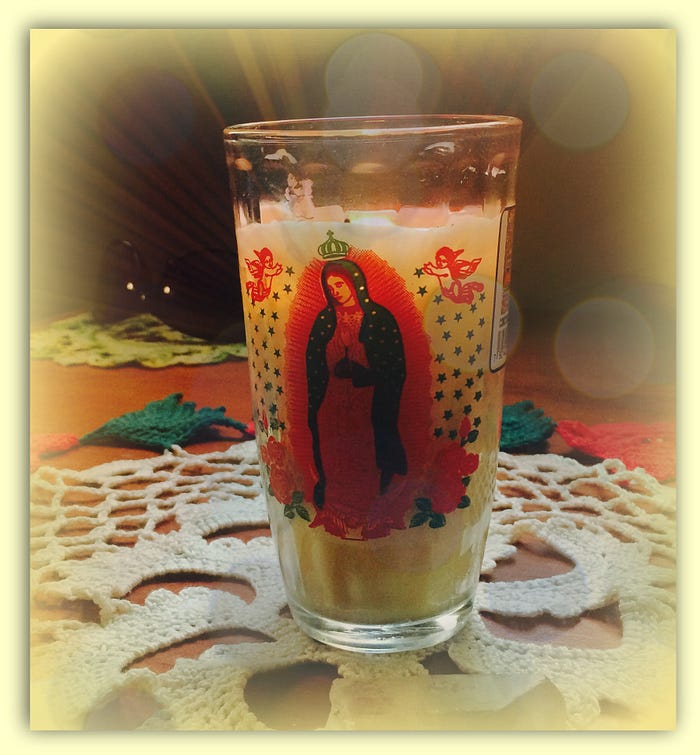
Nuestra Señora de Guadalupe

Notes

(1) In the African Yoruba tradition, there are over 600 orishas or elemental spirits, a complex intricate system of ritual, dance and lifestyle. African religions, of which there are many incarnations on the continent, all share some similarities of a spiritual hierarchy, a monotheistic religion “where secondary divinities, spirits and ancestors provide measured access to sacred power” (Grillo).

(2) Oshun altar found here.

(3)P“Shaking Quakers” in a dance: http://www.utopia-britannica.org.uk/Assets/Shake2.jpg 13 Dec 2012

(4) A Santero priest prays during a ceremony in honor of slaves rebelliousness, as part of the 30th Caribbean Festival in Loma del Cimarron, El Cobre, Cuba. http://news.discovery.com/human/santeria-trance-spirituality-brain.html 12 Dec 2012

(5) Loa is the term for the Haitian deity (Vodoun), which is called an orisha in Santería. Although there may be some cultural differences in names or vevers (sacred symbols), for this discussion of the fifth dimension, loa and orisha are interchangeable. The loa-possessed person transmits energy or even the loa deity to other people with the left hand.

Bibliography

Bourguignon, Erika. “Spirits in Culture, History, and Mind” Journal For The Scientific Study Of Religion 36.3 (1997.

Deren, Maya. Divine Horsemen: The Living Gods of Haiti. NY: McPherson & Co., 2004. Print.

Dyczkowski, Mark. The Doctrine of Vibration: An Analysis of the Doctrines and Practices of Kashmir Shaivism. NY: State U of NYP, 1987. Print.

“Eve.” Encyclopedia of Goddesses and Heroines. Patricia Monaghan. Vol. 1: Africa, Eastern Mediterranean, Asia. Santa Barbara, CA: Greenwood Press, 2010. 85- 86.

Feynman, Richard. Surely You’re Joking Mr. Feynman. NY: Bantam, 1989. Print.

Gage, Julienne. “The Science of Santeria: Do a Little Happy Trance.” http://news.discovery.com/. Discovery.com, 29 Oct. 2009. Web. 16 Dec. 2012.

Gonzalez-Wippler, Migene. Powers of The Orishas. NY: Original Pub., 1992. Print.

Goswami, Amit. God Is Not Dead: What Quantum Physics Tells Us about Our Origins and How We Should Live. VA: Hampton Roads Pub., 2012. Print.

— -. The Quantum Activist. Dirs. Stewart, Ri and Renee Slade. US: Intention Media, 2009. Film.

Grillo, Laura. “African Religions.” Encyclopedia of Women and World Religion. 2 vol. USA: Macmillan Reference, 1999, 6–11.

Jung, C.G. The Archetypes and the Collective Unconscious. NJ: Princeton UP, vol.9:1, 1981. Print.

— -. Jung on Sychronicity and the Paranormal. ed. Roderick Main. NJ: Princeton UP, 2005.

— -. Memories, Dreams, Reflections. USA: Vintage Books, 1989. Print.

— -. The Psychology of Kundalini Yoga. ed. Sonu Shamdasani. NJ: Princeton UP, 1996.

Larson, Rebecca. Daughters of Light: Quaker Women. USA: U of NCP, 2000. Print.

Louchakova, Olga. “Kundalini and Health.” Kundalini Rising: Exploring The Energy of Awakening. Canada: Sounds True, 2009. Print.

Murphy, Joseph M.. Santería: African Spirits in America. Boston: Beacon P., 1992. Print.

Naish, Peter L.N. “Hypnosis And Hemispheric Asymmetry.” Consciousness & Cognition 19.1 (2010): 230–234. Academic Search Premier. Web. 16 Dec. 2012.

Overbye, Dennis. “New Planet in Neighborhood, Astronomically Speaking.” New York Times. 16 Oct 2012, Web. 5 Dec. 2012. <http://www.nytimes.com/2012/10/17/science

Romanyshyn, Robert. The Wounded Researcher: Research with Soul in Mind. New Orleans, LA: Spring Journal, 2007. Print.

Sagan, Carl. The Demon-Haunted World: Science as a Candle in the Dark. NY: Ballantine, 1996. Print.

Shamdasani, Sonu. “Introduction.” C. G. Jung: The Psychology of Kundalini Yoga. ed. Sonu Shamdasani. NJ: Princeton UP, 1996. Print.

Sykes, Bryan. The Seven Daughters of Eve. New York: W. W. Norton & Co., 2001. Print.

Tangaro, Taupouri. Lele Kawa: Fire Rituals of Pele. Honolulu, HI: Kamehameha Press, 2009. Print.

Wells, Spencer. The Journey of Man: A Genetic Odyssey. NJ: Princeton UP, 2002. Print.

(Written in response to Dr. Laura Grillo’s “African and African Diaspora Traditions” Graduate Class Fall 2012 @Pacifica Graduate Institute. Edited for Medium readers.)

Floating Up The Yangtze

*The following is my revision of my non-traditional sonnet, “Lizards Wear Clothes.” I’m updating my Poetry Book for print and this piece seems relevant twenty years later, unfortunately.

The Emperor forgot to wear his clothes.

Constituents fell into clouds of Fools

when steaming golden leeks cooked in the pot

burned black. Heavy water boiled off sticky

temple tangled sentences with empty

words, while lowly interns kissed the Lizards

of crossly Knights. Monkey shouted, “Lizards

get some air and our leader back in cloth!”

Monkey gave up yelling at the empty-

headed lights, floating up the Yangtze. Fools

don’t sense danger as their brains are sticky

cells of grey glop. They smoke a lot of pot,

and anyway, the garden’s gone to pot.

Bunnies chewed the carrots and the Lizards

Back-o-gammoned, while the imps drove sticky

G-cars on a search for royal clothing.

In looking high and riding low, the Fools

spaced out and now the gas tank is empty.

The Naked Monarch screams, “Get me empty

land! We need to piss, Rum; Christ, where’s my pot?”

Rum Man blames the Monkey who blames the Fools

who always blame Bunnies riding Lizards

who eat Cajun AHEEE, wearing silk clothes

from Barneys on Madison. Rum Man sticks

Stiletto Dolls on TV stoking Fools,

then buys the Dolls gold houses made of sticks

and bones—legends from the mist that Lizards

believe. Until the telling time empties

all trash, all waste into the sacred pots,

the Monkey wants the Emperor in clothes

now, before the crispy-fried Fools empty

all the golden pots of sticky treasure

into pockets of Lizards wearing clothes.

© 2004

Yangtze River

Keilor’s Poetry Club Chap. 2

Such as it is More or Less

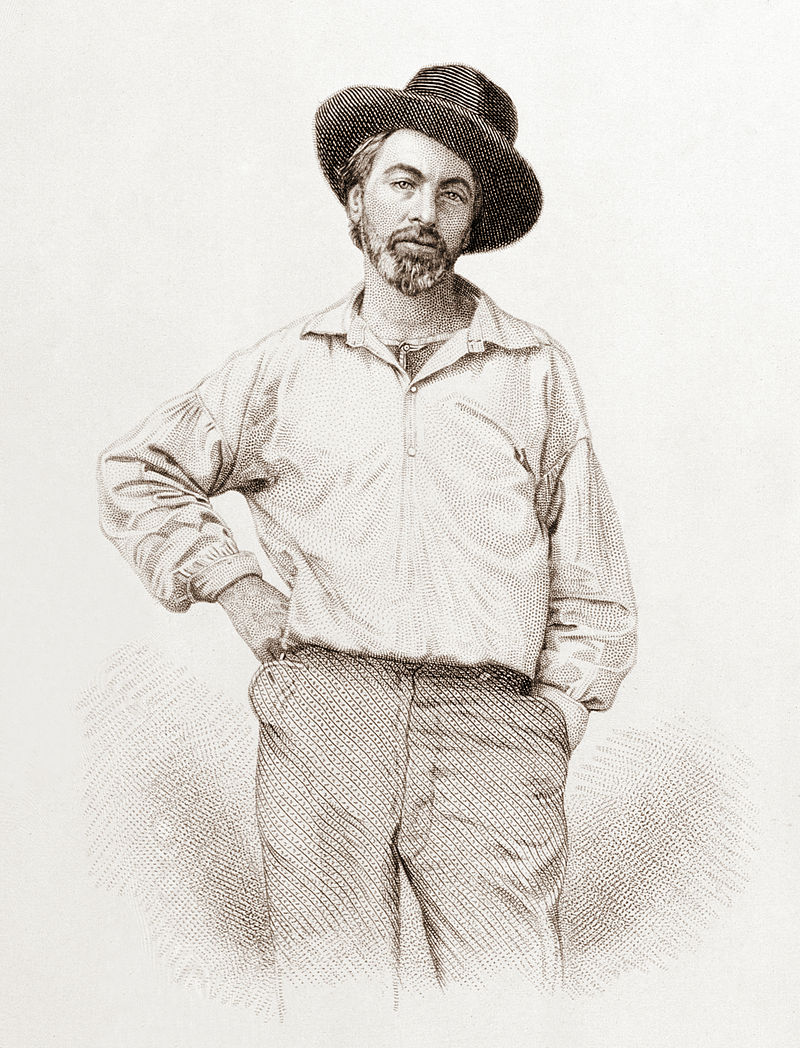
Walt Whitman (1819 – 1892) occupied a lot of my head space in the 90s. I read, re-read Leaves of Grass like I consumed the KJV Bible growing up. He started out as a newspaper reporter in New York, but his passion blossomed into a free-style poetry, so new in the time of strict Victorian verses, a new style—a free wheelin’ man just like his ramblin’ man picture on the cover.

800px-walt_whitman_steel_engraving_july_1854

No stuffed shirt here. And rolling with the Transcendentalist movement in the air around him, he boldly wrote a “Song of Myself”. His line, “The quadroon girl is sold at the auction-stand”, sailed me into another direction.

So, I added a poem to this Chapter. Nikki Giovanni is a woman of color and I think she fits in this Chapter.

Unfortunately, even though her poem was written years ago, it is, as it is in our culture at the moment, more or less. 

Feel free to comment on Nikki’s poem or any other in Chapter 2 in the comment section below.

Allowables

By: Nikki Giovanni

I killed a spider

Not a murderous brown recluse

Nor even a black widow

And if the truth were told this

Was only a small

Sort of papery spider

Who should have run

When I picked up the book

But she didn’t

And she scared me

And I smashed her

I don’t think

I’m allowed

To kill something

Because I am

Frightened

Yolande Cornelia “Nikki” Giovanni Jr.[1][2] (born June 7, 1943) is an American poet, writer, commentator, activist, and educator. One of the world’s most well-known African-American poets, her work includes poetry anthologies, poetry recordings, and nonfiction essays, and covers topics ranging from race and social issues to children’s literature. She has won numerous awards, including the Langston Hughes Medal and the NAACP Image Award. She has been nominated for a Grammy Award for her poetry album, The Nikki Giovanni Poetry Collection.

Fire! Fire! Fire!

Thomas Fire on Ridge
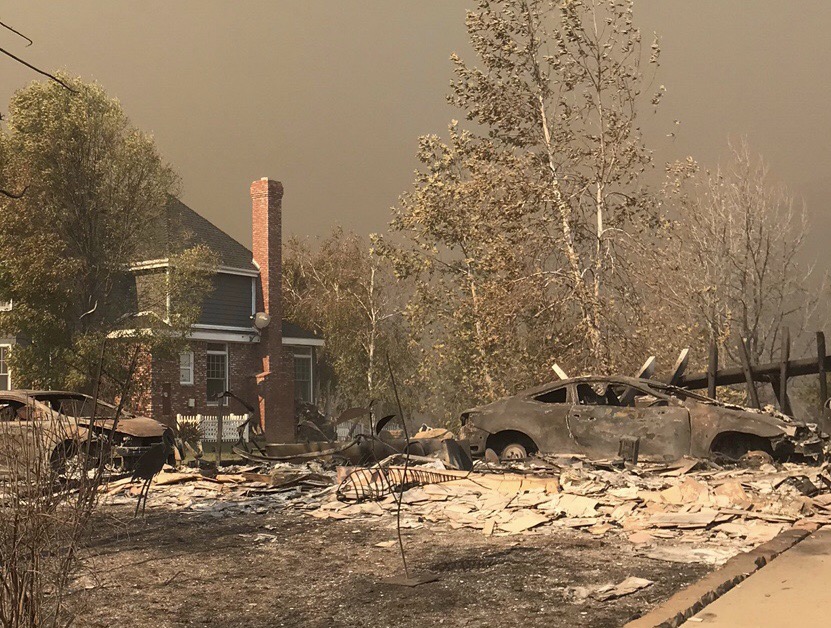
5 a.m. 13 Dec 2017. At night, I can really see the flames—ominous, chewing away, melting everything in its path. A spiraling flare of tremendous red that looks big from where I sit miles away means large things are burning, big trees, maybe big buildings, maybe oil business paraphernalia and then comes the black smoke, which contains the particles of a hotter fire that’s extinguished items of purpose, now some new old purpose.

The fire keeping me awake this dark morning is on the peak of a mountain ridge across the Upper Ojai Valley in Southern California from where I sit on a deck that didn’t burn in the fire when it came through here. This valley, my valley on a plateau that stretches between Ojai Town and Santa Paula for about ten miles is burned through, so they say, although earlier this night a house across the road that survived the #thomasfire caught fire when the electricity was restored. Seems to me the fire gods are having their own say. Little pockets of smoke reveal fires in our yard and all over the hills from roots slowly burning which may take weeks. Some smoldering fires are oil seeps, a local item that springs up along fractures in the earth in this part of the world and they may burn a long, long time.

There are many big fires still burning all over Southern California: Thomas, Skirball, Sylmar, Lilac, probably more. Without TV or reliable Internet, it’s hard to keep up. No rain for months coupled with 70mph Santa Ana winds lit up the sky around me nine days ago and with little warning, Eric and I with our precious dog, Rocco, drove away fast with flames all around.

The #thomasfire, my fire, burned up and spewed out everything around my abode: cars (my car), homes, ancient oaks, animals trapped in barns (not my animals), trailers, garages, fences, pictures, tools, golf clubs, books, family heirlooms, family Christmas ornaments…the animals trapped in barns haunt me in my sleep.


But by some miracle the house did not burn. But why not? Not one window broke in this wood Victorian, including the fireplace logs leaning against the house. Maybe the recently watered grass and trees that surround the house, maybe the wind changed or maybe the fire gods didn’t need it on their march, doing what they do, burn, burn, burn.

The irony is we create our own disasters by doing what we do, building things where fires have always burned, but where on the planet is there not Nature calamities for human-born projects? Flood, tornadoes, hurricanes…btw Nature runs things on this rock, in case we all forgot. We are merely allowed to reside in the beauty for a very brief span of time.

On this day many of my memories and the comforts of home for a lot of my neighbors now reside in piles of ash, totally unrecognizable from their previous state. The remarkable thing about humans is the desire to mold that dust back into some sort of tangible thing to hold or love whether it be a structure or a handmade quilt. This valley is so unique, so beautiful, I bet they’ll all rebuild. Maybe it’s easier for me, having already gone through the process of losing my home and precious belongings in some other disaster seven years ago. I survived and my life got better. And if old-timers know, I’m told the fires are done with me, for now. But I keep my mother’s quilt nearby just in case we need to run again.

6 a.m. Dawn. The rooster just crowed!  I thought he was dead because of his silence these past nine days. I know it’s the one before the fire because he has a particular skrackle-doo. What a great morning! And anyway, I can’t see flames in the daylight.

weSPARK Creative Writers

cropped-maui-water-fotolia_62938951_l-copy1.jpg

Introduction

Mentoring a Creative Writing Class for weSPARK has been a remarkable experience for me, and I feel very blessed and honored to have met some wonderful people in this process. As a non-profit that is “dedicated to enhancing the quality of life for cancer patients, weSPARK has become “home” for many people trying to survive the chaotic events around cancer. My husband died of pancreatic cancer (2011) and recently (2016) my dear sister died with kidney/brain cancer. The suffering of everyone involved, the people with cancer and the people who love them, is inescapable and incalculable.  After Roger died, I fell apart. Slowly, I rebuilt my psyche and forged a new life. One of the tools I used to do this was writing and that resulted in a book: Memory Clouds: Good Grief Bad Grief. 

Regardless of any success for my work, my life has continued to bloom and soar in all directions. I owe that, in part, to the benefits I get from writing.

Working with the beautiful, talented people in my class at weSPARK, which lasted four sessions, specifically helped me process the grief surrounding the recent cancer death of my sister. We all have to deal with grief eventually. I suggest writing as one way to help in process.

The following poems and scenes were generated

from our class.

For the poetry, I gave everyone the same two prompts (one of the prompts was the picture of the ocean at the heading of this intro). The diversity of subjects is a testament for the variety of talent in our class. For the scene descriptions, I asked the writers to describe a place using our five senses. Out of this, I asked them to come up with characters to step into their scenes and talk, and that dialogue was read with great enthusiasm in class.

Many thanks to the writers who are sharing their work (see below).

My heart to yours,

Connie

pain

WeSPARK POETRY

An Homage to Friends Seen and Unseen by Beth Brown

The life I knew quickly came to a halt.

I think I hear the attempts to communicate

Or is it a way for me to really listen to my longing heart?

In the middle of this chaos, I finally heard the laughter…

Laughter from another place

And…

Reassurance that life goes on

And…

Now with me, more present, more alive

Sometimes I feel freer than ever before

Those on another plane have come to my aide with grace

Are they the saviors of the world?

Are these the new mediators?

Somehow many others have heard my cries

And…

Seen friends new and old have also aided me with grace

And…

Advice, comfort, and delicious delights

Either way, I gratefully accept the support whether

Spiritual or corporeal


Three Haiku by Joyce Kane

Acolyte pilot

Lands aircraft, eager to set

His suicide bomb

***

Bodhissattva swoons

Buddha’s hand lifts, flame ignites

Love explodes on earth

***

Squirrel toes red bark

Six nipples, soft dangling cones

Claws clasping acorn


 Three Poems by Andrea de Lange

Tranquil Night – Limerick

There’s magic at twilight, tonight
Colors pop in the glimmering light.

The jasmine’s in bloom,

And there’s plentiful room

For the feeling that all is alright

***

Jasmine

The scent of jasmine is thick as a fog

It fills me up and feeds my soul.

Its essence soothes my mind

And the tension drips away

My muscles surrender to the newness of calm

At this moment, it seems all is right in the world

***

Tranquil Knight

He was a tranquil guy

Not your typical knight.

He spent his spare time

Writing poems and whittling wood.

He wasn’t aggressive,

And didn’t like to fight.

He’d rather be daydreaming,

And finding figures in the clouds.

Like most knights, he was loyal,

And chivalrous to the core.

Luckilly for him,

There was peace, and not war.


Poem by Sara Davenport

She climbs.

The ache of her bones comforts her.

She knows the dirt, but not the ground she explores.

She does not look back at the cold unmoving calm.

Only Forward

Searching outward

Trying to catch the wind.


Tranquility by Jan Finer

To have some faith and trust would help

Allay my frequent fears.

The worries and the what ifs

Have plagued me through the years.

I’ve often felt I’m doomed to stress

And can’t claim calm and mellowness.

My goal, in life, will always be

To conquer what now conquers me.


Lullaby and Goodnight By Lynn Smolen

Lullaby and Goodnight, a touch of madness in my prison of eternal life.

I sat upon a rock. Here the earth met the sky, the horizon peaked through the night in the moonlight a path in the water broken by the rising dorsal fin slicing through its surface. Its silent assent blended with the crashing waves. I watched it come. So like me, the mighty hunter, the Great White Shark. Behind me sea lions slumbered. Not knowing what waits for them in the coming dawn.

Another lay upon the sand. His blood still warm upon my lips. He wore the mark of the vampire on his neck.

Foolish man. He, who hunts with his crosses and stakes, knows not who he trifles with.

I stood upon the rock, the wind had risen. I raised my arms and turned into it and vanished as I came.

Heart shape tree on green grass field. Love symbol, banner

SCENE WORK

The Vineyard by Sara Davenport

Row after row of knobbed and twisted Ts reaching out for their caretakers offering fruit in exchange for water. Edges of the grounds are lined with olive trees dropping slippery seeds leaving streaks of heavy oils on the ground. Jasmine awakes as morning glories nod their heads into slumber, their perfumes cling to the ar. Bees pass by humming while they work, building the terroir in the dusty afternoon haze.


Five Senses by Joyce Kane

The smooth, pastel green and white tree stands proud and tall, covered with rough, thick, orange sheaths peeling off in chunks. Rust, grey and brown patterns snake and intertwine like fingers across the pale trunk, creating strange shapes like an abstract painting. A squirrel head with pink cheeks and button eyes peers out between curving strips of shining sienna skin. A forlorn man with one big, hollow eye holds a walking stick, a black feather falling from his brow.   A brown baby elephant sits on his haunches, reaching down with his thin snout. A man with round, white eyes and a funny khaki hat stares at nothing. Long, rectangular strips of wet, yellow bark bend and lift up, revealing glowing lime wood speckled with tiny pinpoint holes. Raindrops glisten as they run in rivulets over interlacing patches of red and brown bark. A breeze streams drizzle through the air.

Leaves gently rustle, then shiver in waves high above, crinkling like paper. Long, thin, pointed chartreuse blades drop like spinning darts down onto muddy grass. The fresh, invigorating smell of mint wafts with the damp air. I breathe deeply, the scent filling my lungs. I lick cool, soft rain on my lips, taste the fresh water on my tongue—grateful for the swaying, majestic eucalyptus in the storm.


I Was There…Were You? The 80’s by Beth Brown

(The Atlanta Limelight)

Thump. Thump. Thump. The bass was hypnotic. Where was my friend? We’d come here together and now…I don’t know. But, all the beautiful people dressed in crushed velvet, boots, gold chains, and fringe were there. Strobe lights illuminated the rhythm of the dancers on the floor, on the dancing platforms above the masses and even glistened off the koi and gold fish swimming underneath the dance floor. Where was I? We’d come here out of curiosity, and though I thought I’d never been here before, it seemed familiar. Red ropes and green velvet curtains hid the activities behind me where I now suspected my friend to be. Thump. Thump. Thump. It was loud.

I sipped at a drink that was sickly sweet and took an empty seat at a previously occupied table. The place was glamorous and fantastical, but had a familiarity to it that I couldn’t place. Observing the layout, I noticed the long railing behind me, the circular pattern of the room and the barely noticeable but still there, the tragic/comedy masks of theatre hanging above the dance floor like a guiding star to someone who would notice. Is that a Gloria Gaynor song playing?

The dance floor is packed and I’m bored. I concentrate on the Muses above and the realization hit me. The Harlequin Dinner Theatre had been my refuge from engineering school. Here it was turned into what I now decided to be a tacky garish nightclub despite its international clientele. I closed my eyes and images of Molly Brown, The Music Man and other memorable dates came flashing through. How long had I been in my naïve fog before strong pressure on my right shoulder wakened me from my innocent memories. “You can’t sleep in here!” The baritone voice boomed. As if I could. Gloria Gaynor’s “I will survive” began to crescendo as I looked around and saw my friend parting a green velvet curtain and straightening her dress.


The House on the Side of the Hill by Beth Brown

SCREECH! CRASH! Expletives from a fourteen-year-old boy as he sees what has happened. I looked out of my bedroom window and saw where our brown Pontiac station wagon had hit a Loblolly pine tree. He was driving. I decided to run away. My mother had 132 acres of Loblolly pine trees and knowing the reaction from my father, I could hide out in these woods for a while until the crisis calmed. I called out to one of our mixed breed dogs (part English shepherd, German shepherd collie) to follow me. Skipper had the markings like an Appaloosa horse and was a gentle, sweet dog. I left my room and began to walk fast and then run away from the hissing car and agitated two years younger brother. I could still hear him cursing in the background. I ran through the un-manicured woods and down overgrown trails away from the known paths to the three acre pond. This trail was not familiar and I knew these woods. Blackberry bushes covered parts of the path. They scratched me as I carried on to the end of Mama’s property.

I had now been running about twenty minutes when Skipper and I came to a clearing. The scent from the pines was soothing, and the sight of the rock in the sun was welcome. I sat. The panting dog next to me received a special hug for staying with me. Suddenly he ran off. I peered in the direction he was running and decided to follow him. There before me was a stopped-up stream glistening in the sunlight. Skipper was lapping up water. I looked farther down the stream and to my surprise, I saw three beavers working on their masterpiece. This sight took my mind off the previous events. I don’t know how long I observed them, but I began to notice the afternoon shadows in these woods.

Finding a stump to rest on, I began observing the surroundings. Across the stream and up a hill, more water streamed out of a pipe. I peered further up the side of the hill and saw it. The house was old. The grey horizontal slats were loose. The porch on the left side was leaning because the rocks holding it up were settling in the pine covered ground. The windows were dirty and the screen-door as well as the front door was closed. Wow. I didn’t know anyone lived here. It was on the other side of the stream and it wasn’t my mother’s land, so I just observed. Skipper didn’t seem to notice. As the shadows deepened, I decided to go back home hoping that the crisis had been resolved.

The next day I relayed my experience to my mother and father. They seemed surprised as they knew of no one that lived there either. My father was so curious that he took me to the neighbors and asked them about that area of their land. When I described the house, skeptical looks were exchanged. The neighbor flatly stated, “That house was there about one hundred years ago, just after the Civil War, but it burned down a long time ago and nothing is there now.” In that part of the country, my observations could make me a suspicious character, so we left quietly and never told anyone outside the family. My brother, though, was happy with this distraction as it took the emphasis off of his accident.


The Devil Has Three Faces  (Sherlock) By Lynn Smolen

A closed red floor length curtain was pushed open by a hand disturbing a layer of dust into the air. Sounds blanketed by the closed window were lost as he looked down into the London hustle and bustle of night life, where street lights cast their beams into the fray of moving headlights with the scurrying traffic below, as the glass in the window reflected his shadowed face.

He stood in profile holding a glass of spirits and sipped at it lazily, letting the tartness of its flavor coat his tongue and the heated swallow spread down into his chest. He turned slightly, street light advancing to engulf two thirds of his face and neck polishing his pale skin to a brilliance. His hair black as night was a curly mop cut short, partially covering his ears with fluffed bangs that lay upon his forehead. Elegantly shaped eyebrows were crowns for the beauty of his hypnotizing eyes. Eyes like a cat, pupils black framed by the almost colorlessness of light blue rimmed in black eyelashes. His nose straight was shadowed on one side. Prominent cheek bones gave him an air of nobility. His lips were soft and curved above a strong chin. He was a tall man, standing straight as his youth demanded. His frame was thin covered with an open beige dressing gown over a light blue shirt unbuttoned at the neck and dark trousers, the hem of the dressing gown ending inches above his shoes in total summation of the disposition of his countenance.

He let the curtain go and moved into the room pacing about as a creeping annoyance and a sense of restlessness began to consume him. He stopped and downed the last contents of his glass and put the empty container on a small round pedestal table. Trying to restore balance to his good nature he picked up his violin and bow placing the instrument under his chin, his hand caressing the aged wood. He put the bow to the strings while his bony fingers keyed them and began to play the haunting tune of Danny Boy. Behind him a fire burned brightly in the hearth chasing away the lingering coldness in the corners of the room.

The sweet smell of burning logs filled the flat. On the mantle under a square mirror a human skull rested on a circular box. Adjacent to it was an ivory handled knife, its blade sunk into a pile of unopened letters. A framed­-pinned vampire bat amid various beetles was resting against the wall. Comfortable armchairs, one covered in a plaid throw, the other cushioned in black leather stood on either side.

A lamp burned bright on a mahogany desk littered with papers and a lap top computer. Bookcases with many volumes stacked and slanted nestled on shelves that lined the walls. Multiple rows of black Fleur de lis-like patterns on tan wallpaper behind a brown couch clashed with the red Persian rug on a dark wood floor.

The music ceased as he felt the whisper of breath upon his ear and coated arms encircled his waist. He spoke, the deep richness of his voice tipped with mounting hostility, “You are late. I was beginning to think you were not coming.”

“Not so late. Don’t be angry,” she said resting her head upon the back of his shoulder. “You know I could never resist the invitation to dine with you.”

The devil has three faces.

“No, you couldn’t.” He replied pulling away from her and putting down the violin and bow. He crossed the room removing his dressing gown tossing it on the couch as he went to a closet opened it and took out a scarf wrapping it about his neck. He removed a coat from the hanger and shrugged into it turning the collar down. From the inside coat pocket he removed a small pull out magnifier and from the outer pocket a pair of black leather gloves. He put them on a shelf above the rack of long topcoats. The shelf stacked with blankets and pillows.

“Fool,” he muttered to himself as he put his hand under the blankets and removed a folded knife and put it it the outer pocket of the coat. He shut the closet and buttoned up the coat as he walked to the door of the flat. He opened it gesturing her out with a sweep of his hand. She passed him and waited on the landing of a descending back staircase leading down into a hallway as he shut the door behind him. He passed her quickly and went down first with her following.

“You are famous you know,” she said from behind him catching up. “How do you feel about that bloody awful name the London Times has given you?”

He stopped his descent, turned and looked up at her. “Ah…the new celebrity of White Chapel…Jack… Jack the ripper. How do I feel about it?”

He smiled broadly and clapped his hands together like an excited child. “Inspired,” punctuated by a click of his tongue. His right hand went into his coat pocket and he caressed the pocket knife within. He turned and continued down the stairs, his good humor restored. He reached the bottom and proceeded down the hallway, stopped at a mirror on the wall and pushed back the fallen locks on his brow before opening the outside door for her as they went out down two steps onto the sidewalk.

On the pavement she said along side of him. “You know he’s looking for you?”

He laughed then. The warmth of his breath dropping onto the cold air in a puff as he said, with an over confident air, ”Who? That idiot detective on Baker Street. Not a chance in hell he will ever find me.”

“Don’t be too sure,” she said as he went into the street to hail a cab.

In the distance Big Ben chimed the quarter. Bong…Bong…Bong.

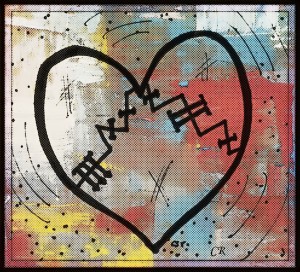
Heart Repaired

THANK YOU JUANES FOR HAVANA PEACE CONCERT

It’s been ten long years since my visit to Cuba. Con Cuban Street Crop

At that time, I wrote about the recording studio, Abdala, for EQ Magazine and fully expected to return soon to continue my love affair with the island, the music, and the people, but historical events botched my plans; in particular, the selection the following year of Bush and friends in D.C. and their allies in South Florida. Couple this with the strangle-hold Castro & friends have on free speech on the island and what is left is an escalation of anger and embargo policies.

These different factions closed all doors leading in and out of Cuba for citizens of the United States. Imagine. My passport does not let me go everywhere anymore—at least not without incurring the wrath of my government. Depressing. And sounds a lot like a communist country. The irony. An island a mere 90 miles from my house in South Florida is off limits.

But today, I see a ray of hope, and once again music leads the way. I watched John Denver open up closed doors in Russia in 1984 and in Havana, Cuba earlier today, Juanes, an award winning fusion rock singer/songwriter orchestrated a Paz Sin Fronteras Concert, in spite of threats from the usual suspects in South Florida—Cuban Americans who think only of revenge and retribution—not the way forward in any relationship I’ve been in.

In Che’s Revolution Square, where I stood practically alone with my daughter a decade ago, a sea of people (over 700,000) congregated to watch Juanes and friends.
Juanes Concert

And from the live feed on NBC, I could feel the joy of the long suffering people of Cuba as they exploded into song. May this be another stepping stone on the path to reconciliation between the U.S. and Cuba. I know so many Cubans on the island and in Miami that want this.

As an outsider looking in, it feels like the anger of this Cuban Civil War should have been diffused a long time ago. My own U.S. Civil War still rages on in some ways, so maybe I’m just a Pollyana. But it seems to me that if the Cubans in Miami had truly wanted to get rid of Castro they would have kept the dialogue and the doors open. Culture and human nature would have taken care of him.

But the Miami group that desires revenge and retribution on an entire island of people, who mostly had nothing to do with any of this disaster, except for their accident of birth, perpetuates a failed policy that has led to the misery of 11 million people who in many ways endure their suffering as a badge of martyrdom: the “Us Against the World” type of martyrdom.

I will never forget the college-educated Cuban girl I interviewed for my article who candidly told me off-tape in a resolute tone that she foresaw “no hope” for things ever changing for the better in Cuba. Heartbreaking. At the time, I believed her wrong, but thus far, she has been right. And things got a lot worse soon after.

I don’t presume to know how it feels to lose your home and your loved one, only to watch the villains of this crime (Castro & friends) go unpunished, and continue to survive and somewhat thrive. It must be miserable beyond words. But how does punishing an entire nation of mostly innocents fix any of this pain? Embargoes don’t work. Pain begets pain. La paz genera paz.

Thank you Juanes and friends for this concert—so nice to see Los Van Van once again. In 1999, angry Miami Cubans pelted me with cans as I entered a theatre to hear a Los Van Van Concert. As a musician, I refuse to let any one group tell me what music I can listen to. In my life, music trumps politics, especially failed politics.

Time will tell if things can really change, but maybe through new efforts and new policies, especially those of our new President Obama, one day I will get to return to Cuba and resume my quest to explore the island in the flesh, instead of in my mind.
Juanes' Paz Sin Fronteras

Death of a Pig

1 thing leads 2 another. At 1st, I was turned off by E. B. White’s title, Death of a Pig, & was determined not to read it. Sometimes I can’t take much gore. But, I couldn’t help myself, I read White’s story.

charlottes-web

I thought it was going to be about slaughtering a pig, but instead, it was about caring for a pig that White was going to slaughter, but ended up not, because the pig got sick & died. Poor pig. White agreed.

And then White said,  “I noticed that although he weighed far less than the pig, he was harder to drag, being possessed of that vital spark.” whitedachshund1So much is in this one thought. White’s talking about his irascible ten-pound Dachshund, a mini might, who he had to haul away from the hundred pound pig’s grave. Life is vital & willful.

I can only dream to write with such humble force. White led me to Montaigne’s The Essayist. I’m not that familiar with Montaigne, but somehow White led me to him. Montaigne is writing over 400
 years ago in a style that I can now see informed many writers I love…candide1

Voltaire being one.

Montaigne’s warning in On Books gives me pause: “Mistakes often escape our eyes, but it is the sign of a poor judgment if we are unable to see them when shown to us by another.” I struggle daily to find my own voice in word or song, & lines like that drive me crazy.

Shouldn’t it matter who is pointing out your mistakes? Am I even seeing all the criticism lobbed my way? Do I ever question the critic? What is a mistake? Turning right on red when the sign says, “Don’t turn on red” is a mistake. Using sentence fragments & calling it poetry, or numbers for letters as a techie innovation that seems to be leading us back to hieroglyphics, might be called a mistake by writers who stick to so-called rules, but is it?

Is having an abortion a mistake or poor judgment, or a logical choice on a planet where thousands of unwanted children die every day? I guess, Montaigne was speaking in the woo-woo Land of the Hypothetical. In Montaigne’s The Commerce of Books I found this jewel: “In books I only look for the pleasure of honest entertainment: or if I study, the only learning I look for is that which tells me how to know myself, and teaches me how to die well and to live well.”

That takes the pressure off—just read what entertains me. I never really cared about learning useless facts that add no pleasure to my life, anyway, such as there are more pigs than humans in Denmark, almost 5:1. pigs1Learning that 5.4 million Danes are subjected to the smelly poo of 25 million pigs informs me of nothing about myself or offers any clues as to how I should live or die. Most likely in this, Montaigne & White would agree.

Some days, I wish I could be White’s beloved pig instead of a worrisome middle-aged writer on the verge of something or another.

Oh to be immortalized in print by such an excellent wordsmith. The pig didn’t worry about deadlines or paying bills…or analyzing personal & professional mistakes. He did suffer a couple days at the end, but he didn’t go through the indignity of being eaten. Yes,  he was dead & who cares, but how do we know?

No swell way to die/ this flesh-eating frenzy/ whether pig, man, or writer.

Dead or alive, I fear I will always feel every rejection letter, every no thanks, & no way—another bit of flesh off the bone. And who has time to learn how to die well? Living occupies my every waking moment.

conpigcrop_12Other days, I’m not so worrisome (like today), & chow down on a ham & cheese—honey ham for me.  After all, there is no such thing as swine flu–it’s really the H1N1 virus.

I tug & pull at my leash, a regular feisty Dachshund. Let’s go this way!

Like White says, once you’ve given a pig an enema, there’s no turning back. Strip away all the trappings & just rite [sic].